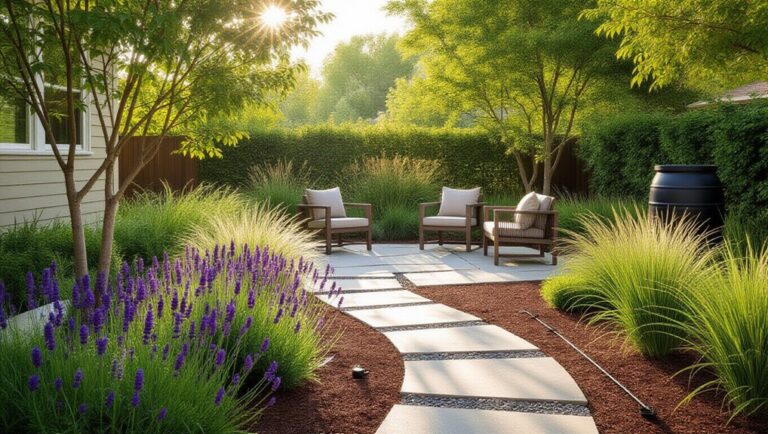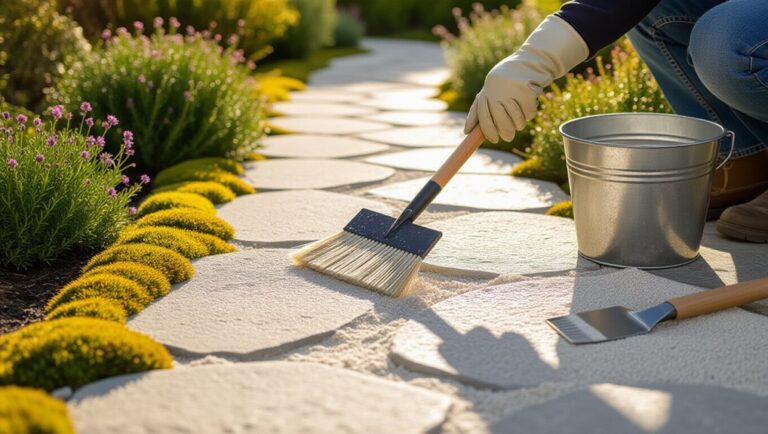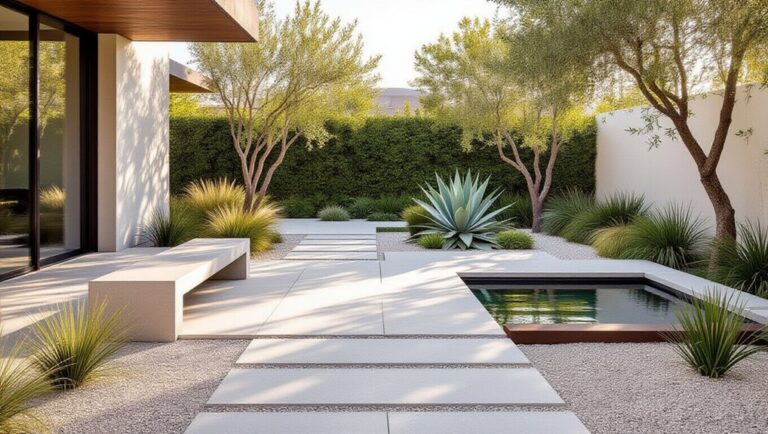
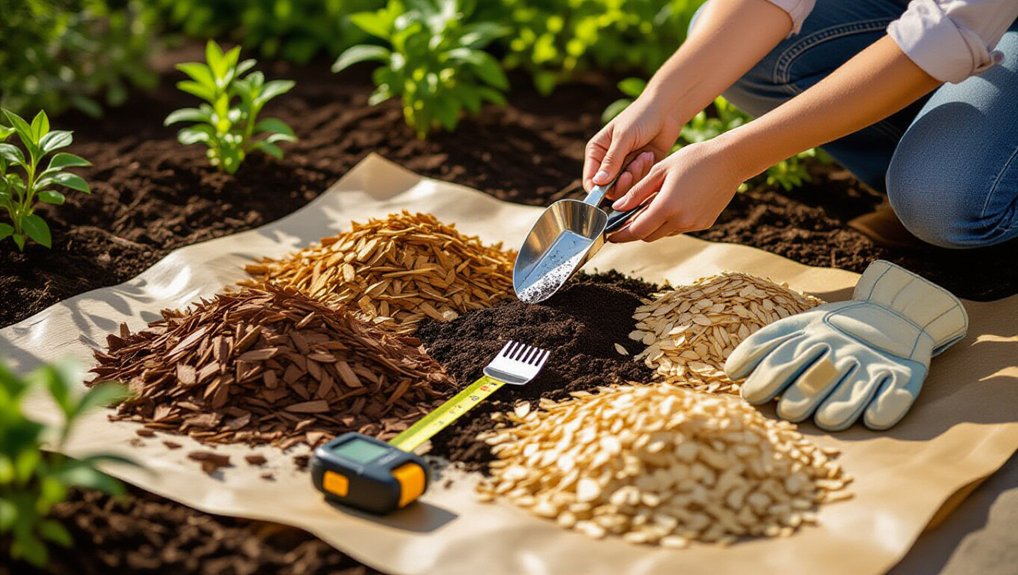
Start by deciding what you need mulch to do: conserve moisture, suppress weeds, control erosion, enhance color, or reduce soil splash and pests. You’ll usually pick organic mulch (compost, shredded leaves, bark/wood chips) for soil improvement, or inorganic mulch (stone, rubber) for long life and low maintenance. Match texture to soil: coarse for heavy/wet soils, finer for sandy soils. Apply 5–8 cm evenly on moist, weeded soil, keeping 5–10 cm off stems and trunks. Next, you’ll see how to compare materials and calculate exactly how much to buy.
Key Takeaways
- Choose mulch based on your goal: conserve moisture, suppress weeds, prevent erosion, enhance color, or reduce pests and soil splash.
- Pick organic mulch for soil improvement; choose inorganic mulch for longer-lasting coverage with minimal maintenance.
- Match mulch type to plants: compost/leaves for vegetables, wood chips/bark for perennials and shrubs; keep mulch off stems and trunks.
- Select particle size for your soil and site: coarser for heavy/wet soils and slopes; finer organic mulch for sandy soils.
- Apply 5–8 cm evenly on weeded, moist soil; leave a 5–10 cm gap around trunks, and top up when depth drops below 5 cm.
What Do You Want the Mulch to Do?
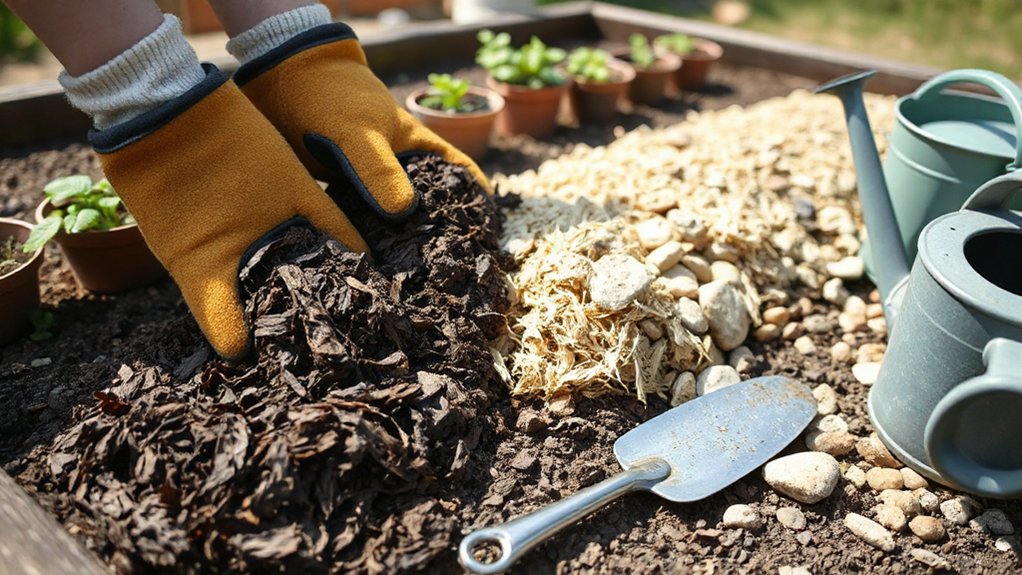
Before you pick a mulch type, decide what job you need it to do, because different materials optimize different outcomes. If you need moisture conservation, choose a mulch that forms a continuous layer 5–8 cm thick to reduce soil evaporation and buffer temperature swings. If weed suppression is your priority, you’ll want a dense, opaque layer that blocks light and limits seedling emergence. For erosion control on slopes, select a mulch that interlocks and resists wash-off under irrigation or rain. If you want Color enhancement, match particle size and hue to your planting palette while maintaining adequate coverage. For Pest control, you’ll aim to reduce pest habitat and limit soil splash onto leaves, which can lower disease transmission.
Should You Choose Organic or Inorganic Mulch?
If you choose organic mulch (like shredded bark or compost), you’ll add carbon and nutrients as it decomposes, and you can improve soil structure and moisture retention over time. If you choose inorganic mulch (like gravel or landscape fabric), you’ll get longer service life and stable weed suppression, but you won’t build soil organic matter. You should match the material to your goal—soil improvement and seasonal replenishment versus low-maintenance durability and heat management.
Organic Mulch Benefits
Although both organic and inorganic mulches can suppress weeds and reduce evaporation, organic mulch gives you an added agronomic payoff because it decomposes into soil organic matter. As it breaks down, you’ll improve aggregation, increase water infiltration, and boost cation exchange capacity, which helps retain nutrients like potassium and calcium. You’ll also feed soil microbes, supporting nutrient cycling and disease-suppressive soil food webs. By moderating temperature swings, you can reduce root stress and maintain steadier moisture in the rhizosphere. Apply a 2–4 inch layer, keep it a few inches off stems, and top it up as it thins. For mulch aesthetics, you can choose mulch color options (pine bark, hardwood, leaf mold) while still prioritizing particle size and decomposition rate.
Inorganic Mulch Advantages
While inorganic mulch won’t build soil organic matter, it delivers consistent, low-maintenance control over moisture loss, weed pressure, and temperature extremes because it doesn’t decompose or compact as quickly as organics. Gravel, crushed stone, and rubber maintain a stable thickness, so you won’t need frequent top-ups, supporting inorganic durability. Their mass reduces wind displacement and can suppress annual weeds when installed over landscape fabric or a properly prepared surface. In hot climates, light-colored stone reflects radiation, helping moderate root-zone heat; in cold snaps, it buffers rapid freeze–thaw swings. You also get predictable Mulch aesthetics: color and particle size stay uniform for years, improving edging lines and minimizing patchiness. Because it’s inert, you’ll reduce nitrogen tie-up and avoid introducing weed seeds.
Choosing Based On Needs
Because your planting goals and site conditions drive mulch performance more than any single “best” material, choose organic mulch when you want to build soil structure and biology over time (compost, shredded bark, leaf mold) and choose inorganic mulch when you need long-lived, low-maintenance coverage that won’t break down (gravel, stone, rubber). For Soil improvement, you’ll get measurable gains from organics: higher moisture retention, moderated soil temperature, and added carbon as they decompose. You’ll also need to replenish them annually and watch nitrogen tie-up with fresh wood chips. For Pest control, match mulch to the pressure you’ve got: coarse bark discourages splashing-borne disease, while thick straw can harbor slugs in wet beds. Use stone in fire-prone zones, but avoid it around heat-stressed plants.
Which Mulch Works Best for Your Plants and Soil?
Since your plants and soil respond differently to moisture, temperature swings, and nutrient cycling, the “best” mulch depends on what you’re growing and what your soil needs most. For vegetables and annuals, use compost or shredded leaves to boost Soil enrichment and microbial activity; keep mulch off stems to limit damping-off. For perennials and shrubs, use bark or wood chips to stabilize soil temperature and reduce evaporation; they feed fungi over time and suit woody roots. If your soil is heavy and wet, choose coarser mulch to improve gas exchange and prevent anaerobic conditions. If it’s sandy, choose finer organic mulch to increase water-holding capacity. For Pest control, use straw under berries to reduce soil splash and fungal inoculum, and remove mulch touching trunks to deter rodents.
Compare Common Garden Mulches (Cost, Lifespan, Weeds)
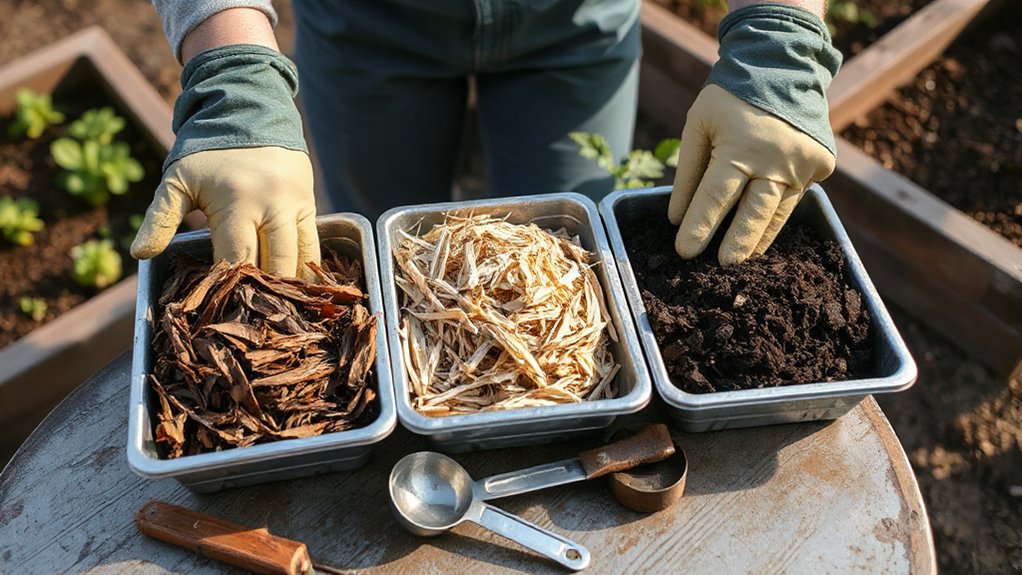
To choose mulch with fewer regrets, compare it on three practical metrics: cost per cubic foot (or yard), expected lifespan before it decomposes or blows away, and how well it suppresses weeds at a 2–4 inch depth. Shredded hardwood is mid-priced, lasts ~12–24 months, knits together, and blocks weeds reliably. Pine bark nuggets cost more, resist decay longer, but shift on slopes and can leak light gaps that sprout weeds. Straw is cheap and insulates well, yet breaks down fast (months) and often imports seeds, so weed pressure can rise. Compost improves soil but offers weak, short-lived weed suppression unless topped with wood chips. Rubber lasts longest, but can heat soil and doesn’t add biology. Match Pest control and aesthetic appeal to your site.
How Much Mulch Do You Need to Buy?
Even if you’ve picked the perfect material, you’ll waste money (or come up short) unless you calculate volume from your bed’s area and your target depth. Measure bed length × width to get square feet, then choose depth based on function: 2–3 inches supports Soil moisture retention and weed suppression; 3–4 inches improves temperature buffering and Pest prevention by limiting soil splash and habitat shifts. Convert depth to feet (inches ÷ 12), then multiply: cubic feet = area × depth. To buy in cubic yards, divide cubic feet by 27. Example: a 10 × 4 ft bed at 3 in (0.25 ft) needs 40 × 0.25 = 10 cu ft, or 10/27 ≈ 0.37 cu yd. Add 10% for settling and irregular edges.
How Do You Apply Mulch Correctly (and Avoid Mistakes)?
After you’ve calculated how much mulch to buy, your results only pay off if you apply it in a uniform, functional layer. Start Mulch installation on moist, weeded soil; remove existing weeds and water lightly to reduce hydrophobicity. Spread mulch 2–3 inches deep for most beds; keep it thinner (1–2 inches) over drip lines and around seedlings to prevent stem rot. Keep a 2–4 inch gap around trunks and crowns to avoid bark decay and vole damage. Don’t “volcano” mulch or exceed 4 inches; overly deep layers restrict oxygen diffusion and slow infiltration. Rake to an even surface and break up clumps. For Mulch maintenance, top-dress when depth drops below 2 inches, and avoid frequent turning. Monitor moisture and fungal mats.
Frequently Asked Questions
What’s the Best Time of Year to Mulch Garden Beds?
You’ll get best results mulching in spring after soil warms (about 10°C) or in fall after first frost. This seasonal timing limits weeds, conserves moisture. Schedule mulch application when beds are weed-free, moderately moist.
Can Mulch Attract Termites, Rodents, or Other Pests?
Yes—mulch can attract termites, rodents, and pests if you keep it wet or against wood. For Pest prevention, maintain 2–3 inches, leave a 6-inch gap, and consider Mulch alternatives like gravel.
Will Mulch Change My Soil pH Over Time?
Yes—mulch can shift pH gradually, like a slow tide. As mulch decomposition releases organic acids and bases, it may slightly alter soil acidity. Wood chips often acidify modestly; compost trends neutral. Test annually.
Is Dyed Mulch Safe for Vegetables, Pets, and Children?
Dyed mulch can be safe, but you must verify environmental impact and chemical safety. Use products labeled non-toxic, heavy-metal tested, and low-VOC. Keep it off edible stems, and supervise pets and children.
Can I Mulch Over Existing Grass or Groundcover Plants?
Yes—you can, like drawing a blackout curtain over a stage. For Grass suppression, scalp grass, lay cardboard, add 3–4 inches mulch. For Groundcover protection, keep mulch 1–2 inches, off crowns; monitor oxygen, moisture.
Conclusion
Choosing mulch is like choosing the right shield for your soil. You’ve defined its job—moisture control, temperature buffering, erosion reduction, or weed suppression—then matched material to biology. Organic mulches feed microbes as they decompose; inorganic layers persist but don’t build structure. You’ve calculated volume, applied 2–4 inches, and kept it off stems to prevent rot. Done right, mulch becomes a measured blanket: conserving water, moderating extremes, and narrowing weed germination.
About the Author