Start by mapping thin spots and checking soil 3–4 inches deep for compaction, waterlogging, or dry, hydrophobic layers; confirm pH stays near 6.0–7.0 and rule out grubs or disease with a tug test. Rake out thatch, core-aerate (two passes), and topdress 0.25–0.5 inch compost/sand to improve infiltration. Water 0.5–1.0 inch per session to reach 4–6 inches deep, mow higher, and spot-patch with seed, sod, or plugs. Next, fine-tune shade, traffic, and weed controls.
Key Takeaways
- Map patchy areas and diagnose causes like uneven watering, compaction, pH imbalance, disease, or grubs before making repairs.
- Rake out dead thatch and weeds, loosen the top 1–2 inches, and topdress thin spots with 0.25–0.5 inch screened compost.
- Core-aerate compacted zones with two perpendicular passes, then restrict traffic until turf thickens and roots reestablish.
- Water deeply (0.5–1 inch per session) and less often, confirming moisture reaches 4–6 inches to encourage deeper rooting.
- Mow higher with sharp blades, remove under one-third per cut, and apply slow-release nitrogen to boost tillering and density.
Diagnose What’s Causing Your Patchy Lawn
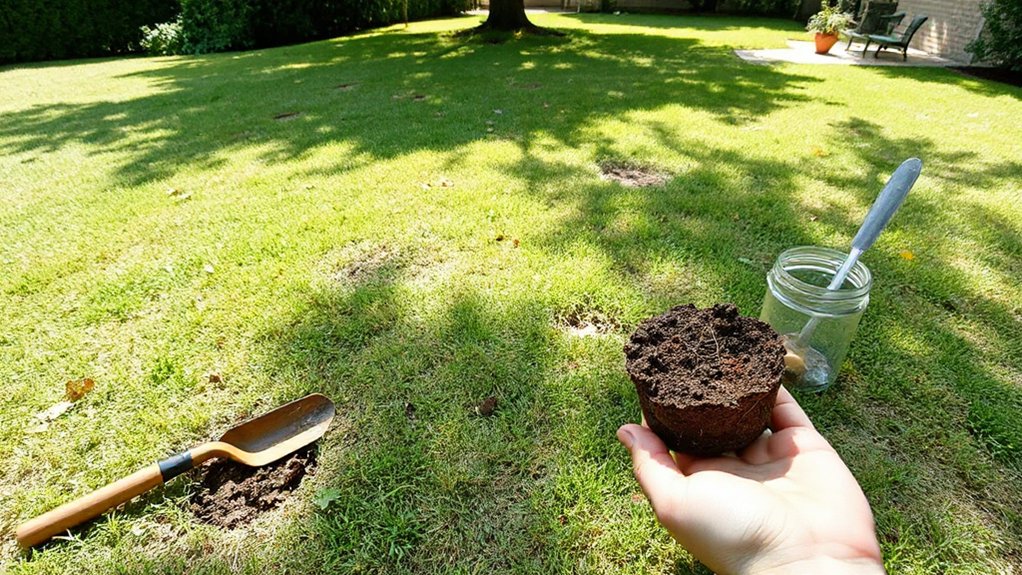
Before you buy seed or fertilizer, pin down what’s killing or thinning the turf by running a quick, stepwise check of the site. First, map patch locations and note sun hours, slope, and irrigation overlap; uneven moisture drives thinning. Next, probe soil 3–4 inches deep: if it’s compacted, waterlogged, or hydrophobic, roots can’t persist. Measure soil pH with a calibrated kit; most cool-season grasses decline outside ~6.0–7.0, and micronutrient lockout mimics “dead” grass. Then inspect crowns and blades for disease patterns (rings, streaking) and confirm with a tug test for rotten roots. Finally, check for pest infestation: lift sod at patch edges and count grubs per square foot; also look for ants, chinch bugs, or animal digging.
Quick Triage: Fix the Worst Bare Spots First
Once you’ve identified the likely cause, triage the lawn by tackling the largest, most visible bare spots first, because they expand fastest and invite weeds. Mark each area, then measure its size so you can match treatment intensity to damage. Rake out dead thatch and loose debris, and cut a clean edge so repairs knit into surrounding turf. Loosen only the top 1–2 cm, then topdress with a thin layer of screened compost or sandy loam to stabilize moisture. Check Lawn color around the margins: yellowing suggests water stress, while bluish-gray indicates drought; correct irrigation before you patch. If you find grubs or chewing, apply targeted pest control and delay cover until feeding stops. Finish with mulch and consistent moisture for 10–14 days.
Aerate or Dethatch to Relieve Compacted Soil
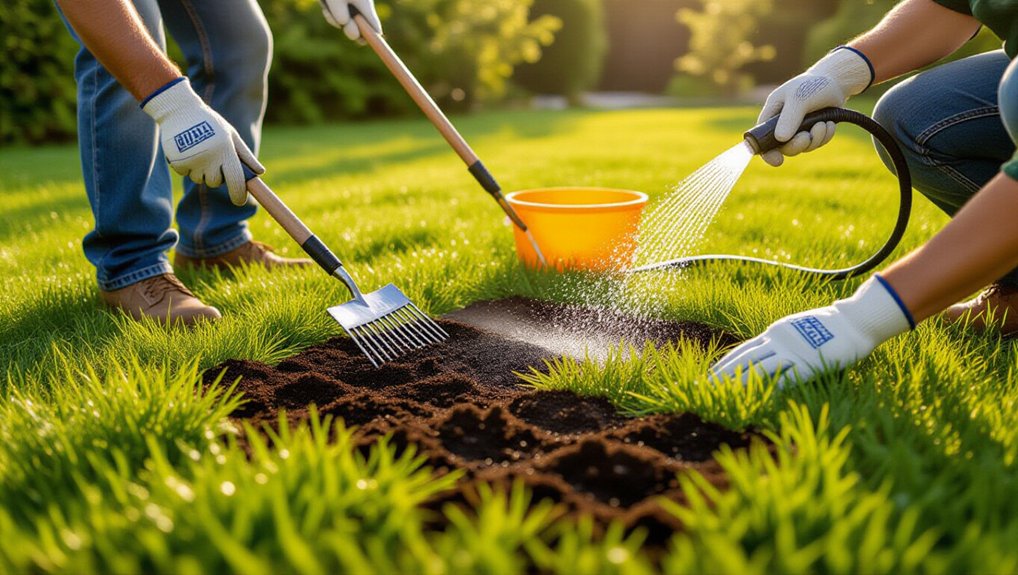
If your soil feels hard underfoot and water runs off instead of soaking in, aeration or dethatching will restore pore space so roots can access oxygen, moisture, and nutrients. First, diagnose: push a screwdriver 10–15 cm into the turf; resistance signals soil compaction. Check thatch by cutting a small plug; if the spongy layer exceeds 1 cm, dethatch. Next, choose the tool: use a core aerator that removes plugs, not solid spikes, to create lasting channels. Make two passes in perpendicular directions over thin areas. For dethatching, use a rake or power dethatcher and lift debris without scalping crowns. Finally, topdress lightly with compost to keep holes open and improve root development. Keep traffic off until recovery begins.
Water Deeply to Revive Thin Grass Roots
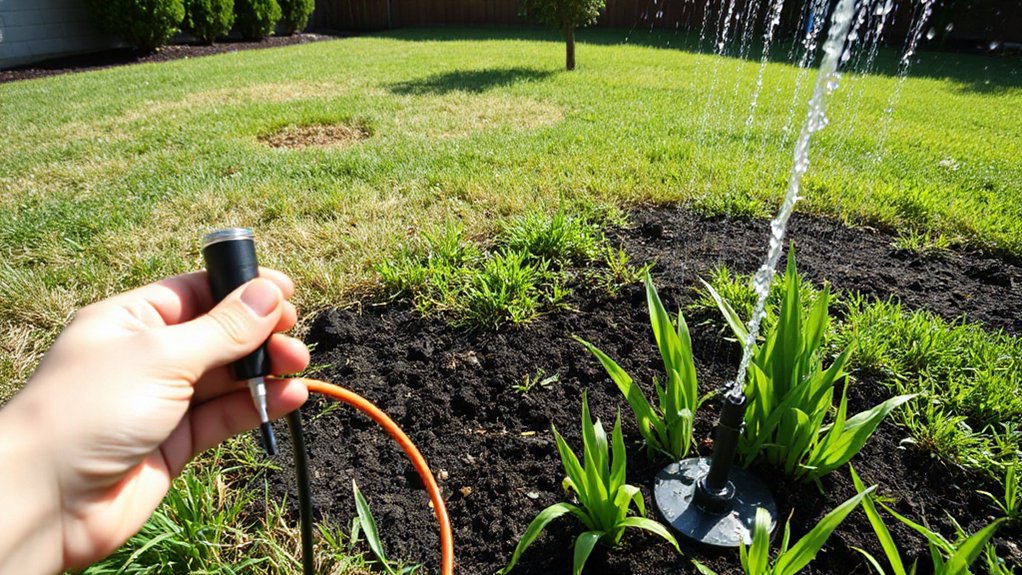
Aeration and dethatching reopen the soil profile, but deep, infrequent watering is what drives roots to follow that improved pore space downward instead of staying shallow. Start by measuring output with rain gauges or tuna cans, then irrigate until you’ve applied about 0.5–1.0 inch in a single session. Verify infiltration by probing 4–6 inches down; you want moisture through that zone without runoff. Next, extend the interval between waterings so the surface dries while deeper layers stay moist, forcing Root development at depth. Adjust for Soil composition: sandy soils need smaller, more frequent deep cycles; clay needs slower application and longer intervals to prevent puddling. Water early morning to cut evaporation, and recheck after heat waves or wind.
Mow Higher to Help Grass Thicken Up
Because mowing height directly controls how much leaf area your grass keeps for photosynthesis, raising the deck is one of the fastest ways to push a thin lawn toward thicker, more competitive growth. Set Grass height to 3–4 inches for most cool-season lawns and 2.5–3.5 inches for many warm-season types; taller blades shade soil, reduce evaporation, and favor tillering.
Follow evidence-based mowing techniques: mow often enough that you remove no more than one-third of the blade per pass, and keep the schedule tighter during peak growth. Sharpen the blade to avoid frayed tips that waste water and invite stress. Alternate mowing directions to prevent rutting and crown scalping, especially on uneven ground. Leave clippings unless they clump; they’re not thatch.
Feed Bare Spots With the Right Fertilizer
Start by choosing a high-nitrogen fertilizer blend (first number in the N-P-K ratio) to drive leaf and tiller growth where the lawn’s thin. Next, apply slow-release granules so nitrogen feeds steadily and reduces burn risk compared with quick-release products. Spread it evenly over the bare spots at the label rate and water it in to move nutrients into the root zone.
Choose High-Nitrogen Blend
When your lawn shows thin, pale patches, a high‑nitrogen fertilizer blend can push fast leaf-and-tiller growth to help surrounding grass knit back over the bare soil. Start by confirming nitrogen need: if blades are light green and growth is slow, nitrogen is the limiting factor for lawn nutrition. Next, choose high nitrogen blends with a higher first number (N) than P or K, such as 24-0-6 or 30-0-4, to prioritize shoot recovery. Avoid “starter” formulas high in phosphorus unless a soil test shows deficiency. Check the label for a modest iron component to deepen color without forcing excess top growth. Apply at the product’s recommended rate for your grass type, and water in lightly to move nutrients into the root zone.
Apply Slow-Release Granules
High‑nitrogen blends can jump‑start recovery, but bare and thin areas fill in more reliably if you keep nitrogen available for weeks rather than days. Choose a slow‑release granular fertilizer with 30–70% controlled‑release N (sulfur‑coated urea or polymer‑coated urea) to reduce burn risk and leaching.
1) Confirm needs with soil testing so you don’t overapply nitrogen or miss potassium or phosphorus limits. 2) Mow, rake debris, and lightly loosen the surface so granules contact soil, not thatch. 3) Apply at the label’s rate using a calibrated spreader; treat edges and spots evenly. 4) Water in with 0.25–0.5 inch to activate release. 5) Recheck in 4–6 weeks and pair with targeted pest control if grubs or insects are thinning turf.
Patch Thin Areas With Seed, Sod, or Plugs
Match your repair method to the site: you’ll use seed for cost-effective coverage, sod for instant surface and faster erosion control, or plugs for spreading turf in small thin areas. Prep each spot by raking out dead material, loosening the top 1–2 inches of soil, and firming a level seedbed for solid seed-to-soil or sod-to-soil contact. After installation, you’ll keep the area evenly moist, limit traffic, and mow only once the new grass reaches the recommended height for strong regrowth.
Choosing Seed, Sod, Plugs
Because thin spots rarely share the same cause or urgency, you’ll get better results by choosing the right patching method—seed, sod, or plugs—based on traffic level, desired “time to green,” and how closely you need to match the existing turf.
1) Use seed for large, low-traffic areas where you can wait. Prioritize Seed selection: match species/cultivar to your existing grass and sun exposure, and choose improved varieties with documented disease tolerance. Expect slower cover but strong root establishment.
2) Choose sod for high-visibility or high-traffic zones needing immediate cover. During sod installation, you’ll want fresh, weed-free rolls that match blade texture and mowing height; it roots fastest in warm, moist conditions.
3) Use plugs to repair small holes or to introduce warm-season grasses; spacing controls fill-in time.
Prepping Thin Lawn Spots
Before you drop seed, lay sod, or set plugs, you’ll get better take-rate by prepping thin spots like a mini renovation: identify and fix the limiting factor, then create clean soil-to-root contact. Start with inspection: note Lawn color (chlorosis, drought gray, or dark nitrogen flush) and map sun, traffic, and drainage. Confirm causes with soil testing for pH, phosphorus, potassium, and salinity; correct per results, not guesswork. Kill or remove competing weeds and dead thatch; rake to expose mineral soil. If compaction’s present, core-aerate the area and topdress 0.25–0.5 inch of screened compost/sand blend to improve infiltration. Regrade low spots, then lightly loosen the top 1–2 inches. Moisten soil so it’s damp, not muddy.
Aftercare For Strong Regrowth
Once you’ve set seed, laid sod, or installed plugs, your aftercare needs to lock in consistent moisture, firm soil-to-root contact, and low stress until new roots anchor. Water lightly 2–4 times daily for seed, keeping the top 1 cm moist; shift to deeper, less frequent watering after germination. For sod/plugs, soak to 10–15 cm depth, then keep evenly moist for 10–14 days. Roll or tamp to eliminate air gaps. Keep traffic off and mow only when growth reaches 8–10 cm, removing no more than one-third. Delay fertiliser until you’ve done soil testing; correct pH and low phosphorus if indicated. Monitor daily for Lawn pest damage and treat early. Spot-weed by hand; avoid herbicides until roots knit.
Fix Shade, Traffic, Weeds, and Moss Hotspots
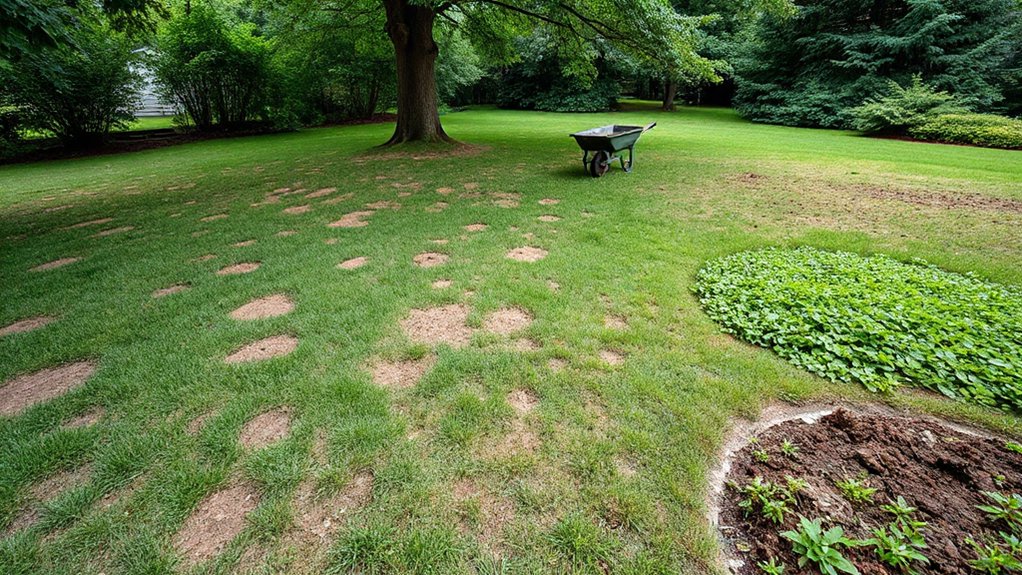
Even if you’ve nailed mowing and watering, patchiness often persists where microconditions stay hostile—deep shade limits turf photosynthesis, foot traffic compacts soil and shears crowns, and weeds or moss exploit thin grass. Start by mapping hotspots by sunlight hours and wear paths, then match fixes.
In shade, prune canopies, raise cutting height, and switch to a shade-tolerant fescue via plugs. For traffic, aerate, topdress with sand/compost, and add stepping stones or reroute paths. For weeds, spot-treat with a selective herbicide only after grass is actively growing; improve density to prevent reinfestation. For moss, correct drainage, raise pH with lime if soil tests low, and rake out dead mats. Watch for Lawn disease and insects; targeted Pest control prevents repeated thinning.
Frequently Asked Questions
How Long Before Repaired Patches Match the Rest of the Lawn?
Repaired patches typically match in 4–12 weeks. Stepwise: test Lawn soil, correct pH, topdress thinly, water daily until germination, then taper; mow at 7–10 cm; apply light nitrogen; continue Patch maintenance to blend density.
Can Pets Safely Use the Lawn After Fertilizer or Treatments?
Better safe than sorry: you can let pets back after Lawn treatments once product labels allow it—typically when granules dissolve and turf dries. For Pet safety, 1) apply precisely, 2) irrigate, 3) restrict 24–48 hours.
What’s the Best Time of Year to Spot-Repair Patches in My Climate?
Spot-repair in early fall (cool-season) or late spring/early summer (warm-season). First, do Soil testing; next, schedule Lawn aeration. Then topdress, plug or sod, and irrigate lightly daily until rooting.
Will Sprinkler Changes Increase My Water Bill Significantly?
Not substantially if you optimize Water efficiency. 1) Audit run times and fix leaks. 2) Perform sprinkler maintenance: clean nozzles, correct pressure, and align heads. 3) Add smart scheduling; reduced overspray offsets upgrades.
How Can I Prevent Patchiness From Returning Next Season?
Prevent patchiness by aerating compacted areas (Soil aeration) in early fall, then topdress thinly. Apply calibrated Lawn fertilization per soil test. Mow high, sharpen blades, water deeply weekly, and control grubs/weeds proactively.
Conclusion
You don’t need to redo the whole yard—target the causes and repair in steps. Start by diagnosing shade, compaction, traffic, and drainage, then triage the largest bare spots. Aerate or dethatch where soil is tight, water deeply to drive roots down, and mow higher to boost leaf area. Apply a spot-appropriate fertilizer, then patch with seed, plugs, or sod. One study found compacted soils can cut infiltration by up to 90%, so aeration often changes everything.
About the Author