Start by mapping sightlines from patios and windows, then set a target screen height, linear span, and a year‑1/year‑3 timeline. Match fast growers to each zone’s sun, soil, and drainage: evergreen hedges for year‑round cover, deciduous hedges for seasonal density, clumping grasses for tight beds, vines on trellises for fences, and narrow columnar trees for vertical blocks. Space tighter on windy sand, wider on irrigated clay, stagger rows, and tip‑prune 2–3 times per season to close gaps fast. Next, you’ll see how to fine‑tune spacing, feeding, and training for maximum opacity.
Key Takeaways
- Define privacy height, span, and timeline, then map sightlines and view cones to measure exact screen lengths and gaps.
- Match fast-growing plants to each zone’s sun, soil, drainage, wind, and space for quicker establishment and fewer failures.
- Use evergreen hedges for year-round cover; space 24–36 inches on-center and stagger rows where space allows for dense screening.
- Add vines on fences/trellises or narrow columnar trees for vertical privacy when ground space is limited.
- Maintain density with consistent watering, spring slow-release nitrogen, tip-pruning 2–3 times per season, and weekly pest scouting.
Set Your Privacy Goal: Height, Width, and Timeline
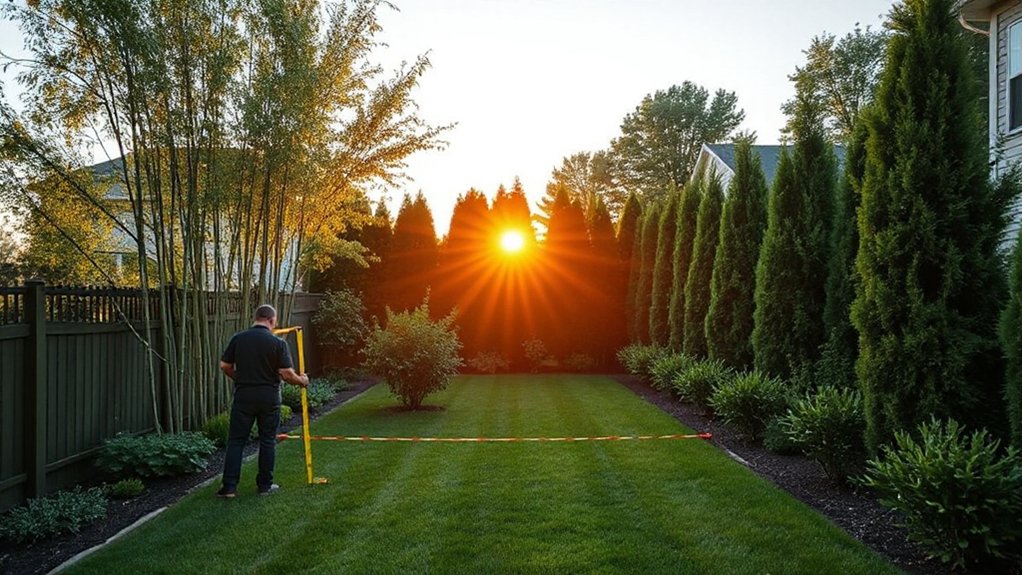
Before you buy a single plant, define exactly what “privacy” means in your yard: the target screen height (eye level from your patio or interior sightlines), the span you need to block (property line length or specific viewing angles), and how fast it has to happen (this season, next year, or over 2–3 years).
Map sightlines from key nodes—patio chairs, kitchen sink, upstairs windows—then draw view cones to the intrusion points. Translate that into a measured screen: linear feet, required height at each segment, and any gaps for gates, utilities, or drainage swales. In Garden layout, reserve planting corridors wide enough for mature spread and access. Use privacy zone planning to phase results: temporary screening where urgency is highest, and long-term structure where space allows, with clear milestones for year 1 and year 3.
Choose Fast-Growing Privacy Plants by Sun and Soil
Map your screening zone by sun exposure—full sun, part shade, or deep shade—so you can specify fast-growing plants that won’t thin out or scorch where you need coverage. Then match your choices to soil type and drainage (sandy, loamy, clay; wet vs. well-drained) so roots establish quickly and growth stays dense along the property line. When sun and soil align, you’ll get a faster, tighter privacy wall with fewer failures and less redesign.
Match Plants To Sun Exposure
Although a “fast-growing” screen sounds like a plant-shopping problem, it’s really a site-matching problem: start by aligning each privacy plant to the exact light pattern on the fence line (full sun, part sun/afternoon shade, or deep shade) and the soil behavior there (drains fast, stays moist, or compacts). Your goal is to match Sunlight requirements to the fence’s daily exposure, then confirm soil compatibility so growth stays uniform. In full sun, you can run tighter spacing because stems harden and foliage stays dense; in part sun, stagger plants to prevent a thin mid-canopy on the shaded side. In deep shade, design for layered screening—tall, narrow forms behind broader, lower foliage—so you block views without forcing sun-loving species to stretch and flop.
Pick Plants For Soil Type
Once you’ve matched your screen plants to the fence line’s light pattern, lock in performance by matching them to the soil’s behavior—because drainage and compaction control root speed, canopy density, and long-term stability. Start with a jar test and a probe: if you hit dense clay at 6–10 inches, choose clay-tolerant, fast-structuring screens (willow, dogwood, elder) and plan soil amendments like compost plus gypsum only if drainage isn’t perched. For sandy runs, prioritize drought-resilient, quick bulk (juniper, pine, sea buckthorn) and add compost/biochar bands to hold moisture. Where water collects, use flood-tolerant species or build a bermed planting strip. Keep plant compatibility tight: match pH, salinity, and root aggression to nearby paving, septic lines, and irrigation zones.
Fast-Growing Privacy Hedges to Block Views Year-Round
To block sightlines year-round, you’ll spec evergreen hedge champions along the property edge where winter views open up, spacing plants to close canopy fast without crowding roots. You can also run rapid deciduous screens on secondary lines to gain height quickly and soften hard boundaries while the evergreen structure matures. Next, you’ll match each hedge type to your setback, wind exposure, and pruning access so the screen stays dense in every season.
Evergreen Hedge Champions
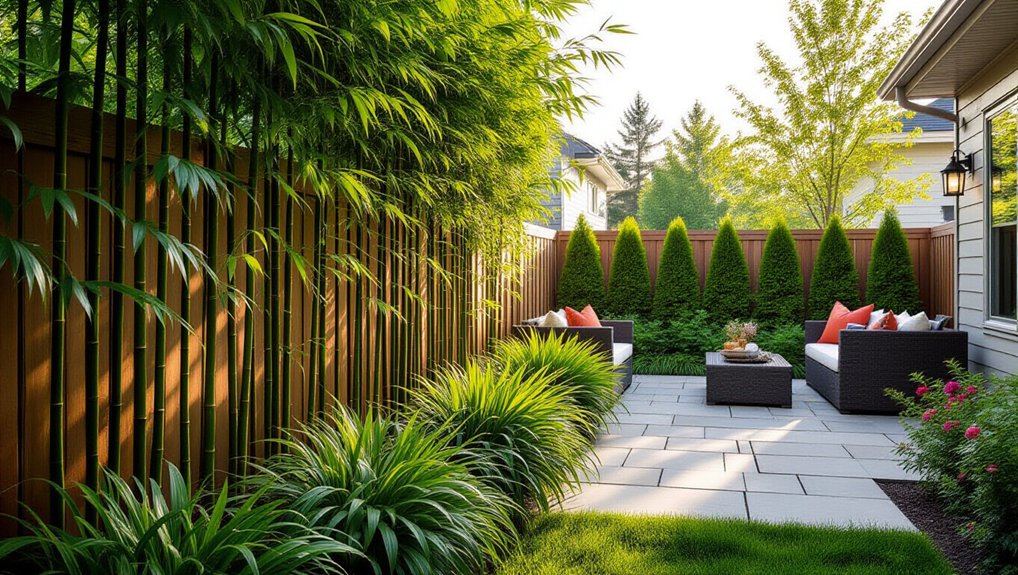
When you need a privacy screen that stays dense through winter, fast-growing evergreen hedges give you the most reliable year-round sightline control and wind buffering. Choose Evergreen hedge champions like Thuja ‘Green Giant’ for tall, narrow corridors, or wax myrtle where heat and salt spray demand toughness. On tight lots, use clumping bamboo in root-barrier trenches to keep lines clean. Set plants 24–36 inches on center for rapid knit; widen spacing on sandy soils to reduce drought stress. Orient rows perpendicular to prevailing winds, and stagger two rows only where you can spare 5–7 feet. Prune lightly in year two to thicken basal growth, and plan seasonal color contrasts by mixing blue-green juniper with golden false cypress at corners.
Rapid Deciduous Screens
Although deciduous screens drop their leaves in winter, you can still block most sightlines by choosing fast-growing species with dense twig structure and sizing them to your viewing angles—use multi-stem shrubs like privet, viburnum, or red-twig dogwood where you need quick lateral fill, and switch to hornbeam or field maple where you want a clipped, formal wall that holds branching density through dormancy. Set the screen 0.6–1.2 m inside the boundary to allow maintenance access and prevent lean. Plant 3–5 per meter for shrubs, 2–3 per meter for trained Deciduous trees, then cut back at planting to force basal shoots. Use staggered double rows on windy sites for turbulence control. Accept Seasonal foliage gaps, but tighten winter cover with annual summer pruning.
Clumping Grasses for Quick Privacy in Small Spaces
Because tight side yards and patio edges rarely have room for spreading screens, clumping ornamental grasses give you fast, vertical privacy without aggressive runners. Place clumping grasses 24–36 inches from hardscape so blades can arch without blocking circulation, and stagger plants 18–30 inches on center for quick privacy at eye level. In full sun, use Calamagrostis ‘Karl Foerster’ for narrow, upright columns; in part shade, try Hakonechloa in masses for softer, lower screening. Match height to sightlines: 3–4 feet for seated patios, 5–6 feet for window buffering. Improve establishment with drip irrigation, 2–3 inches of mulch, and spring cutback to 6–8 inches. Add steel edging to keep crowns tight and clean.
Fast-Growing Vines to Cover Fences and Trellises
If your fence line already defines the boundary but still feels exposed, fast-growing vines can turn that flat plane into a living privacy wall in a single season. Match species to microclimate: evergreen star jasmine for mild zones, hardy kiwi for cold winters, or annual scarlet runner bean for instant coverage.
Use Trellis design to control load and airflow: mount a 2–4 inch standoff wire grid so vines don’t trap moisture against wood, and anchor posts below frost depth. Space vertical supports 6–8 feet to prevent sag. Train leaders horizontally to thicken coverage, then tip-prune monthly. For Vine maintenance, irrigate deeply the first year, mulch the root zone, and thin interior stems to reduce mildew and improve light penetration.
Narrow, Fast-Growing Trees for Privacy Screens
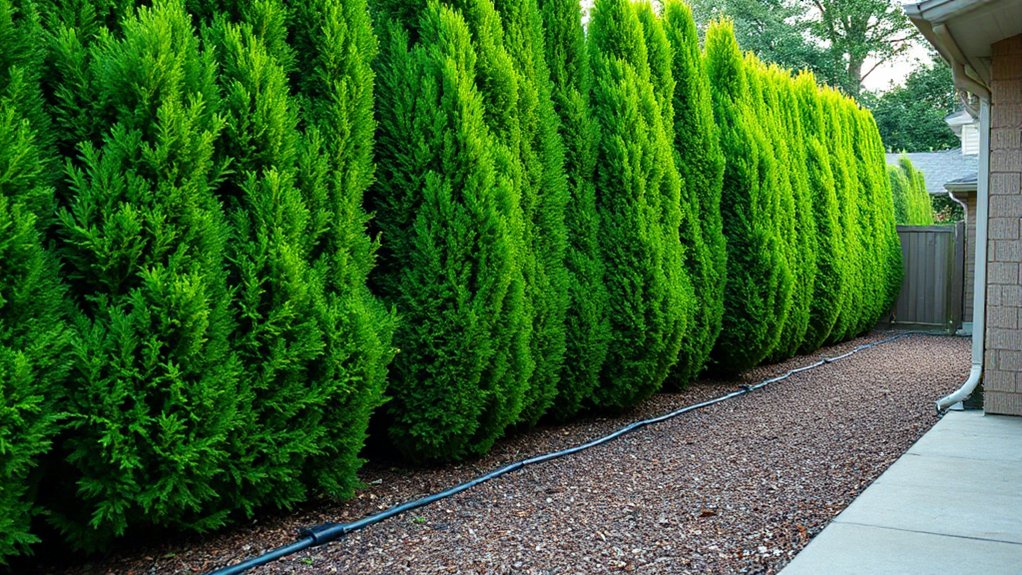
When you need vertical privacy in a tight side yard or along a property line, narrow, fast-growing trees let you build a screen without sacrificing usable space. Choose tall trees that keep a columnar habit so canopies don’t overhang patios, paths, or driveways, and so roots stay within irrigated beds. In full sun, consider Italian cypress or columnar junipers for dry, reflected-heat sites; they read as clean vertical lines in modern layouts. For humid climates and heavier soils, look at upright arborvitae cultivars that tolerate winter exposure and create a softer texture. Use narrow varieties to frame views: place them where you want a hard visual stop, then shift to shrubs at corners for a natural edge.
Spacing, Pruning, and Feeding to Keep Screens Dense
Although fast-growing screens fill in quickly, you’ll only keep them opaque if you set spacing to match mature width, shear or tip-prune on a schedule that pushes lateral branching, and feed in a way that supports steady growth without forcing weak, floppy shoots. Place plants closer on windy, sandy sites; widen spacing on irrigated clay where growth surges. Stagger rows for depth where you’ve got 6–10 feet, but keep access gaps for pruning. Tip-prune new growth 2–3 times during the growing season, cutting back to outward buds to thicken the face, not the top. Use slow-release nitrogen in spring, then a light midsummer top-up only if color fades. Pair feeding with a consistent watering schedule to prevent gaps. Integrate pest management scouting weekly for mites, scale, and borers.
Frequently Asked Questions
How Can I Add Privacy Fast if I Rent and Can’T Plant Trees?
Use temporary fencing and movable screens you can anchor with weighted bases, not soil. Position panels perpendicular to sightlines, stagger for depth, and add tall planters with grasses to seal gaps without permanent changes.
What Privacy Plants Are Safe for Pets and Small Children?
About 70% of common hedging plants can irritate pets; you’ll choose Pet safe shrubs like dwarf blueberry, inkberry holly, and potentilla, and Child friendly hedges like viburnum, spaced 60cm on your fence line.
Which Fast-Growing Screens Are Least Likely to Become Invasive Locally?
You’ll minimize invasive risk by choosing regionally native clumping grasses, serviceberry, viburnum, and elderberry; avoid running bamboo, privet, and knotweed (Invasive species). Match soil/light, spacing, and height; use Native alternatives from local nurseries.
How Do I Keep New Privacy Plants Alive During Watering Restrictions?
Shade as shield, mulch as moat, roots as reservoirs—you’ll keep them alive by zoning drip to rootballs at dawn, using greywater legally, deep infrequent soaking, hydrogel, and strict Plant maintenance with deficit-irrigation watering techniques.
Can I Combine Hardscape Panels With Plants for Instant Privacy?
Yes, you can pair hardscape panels with plants for instant privacy. Use decorative privacy screens as tall fence alternatives, anchor posts in concrete, then soften edges with trellis vines or clumping grasses, spaced to sightlines.
Conclusion
Define your screen, then build it: measure sightlines, set target height and spread, and match species to your site’s sun, soil, and wind. Layer evergreen hedges for year-round cover, clumping grasses for tight setbacks, vines for vertical planes, and narrow trees for overhead filtering. Plant at correct spacing, prune for density, and feed for steady growth. You’ll block views, soften boundaries, and shape a cohesive garden room quickly.
About the Author