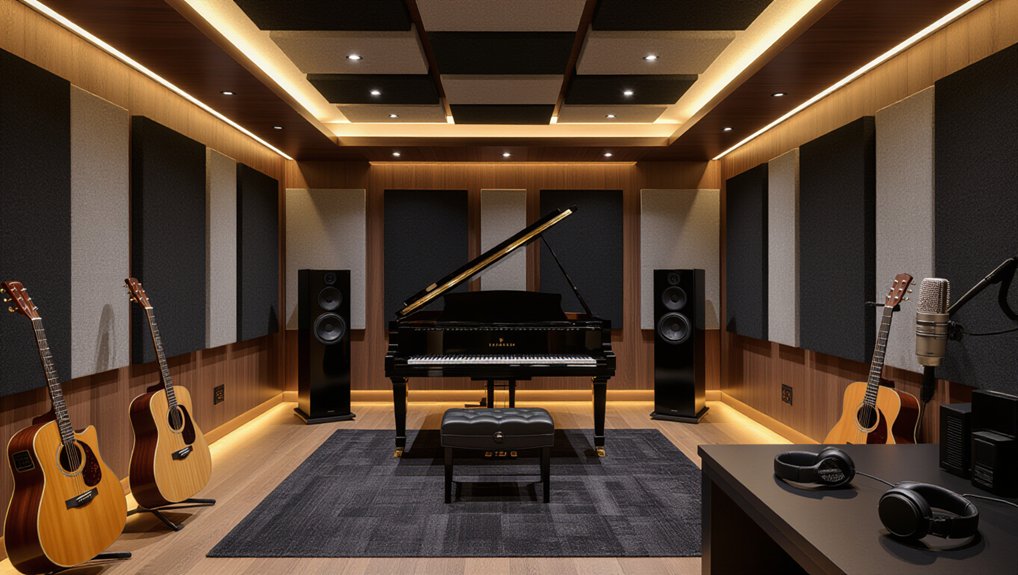
You’ll design a sound‑optimised music room by locking in symmetry first: center your seat on room width at ~38% of room length, then place speakers on the short wall with tweeters at ear height in a 1.8–2.5 m equilateral triangle, 0.6–1.0 m off the front wall and ≥0.5 m from side walls, toe‑in crossing just behind you. Treat first reflections with 50–100 mm broadband panels plus 25–50 mm air gaps, add 100–150 mm corner bass traps, and seal doors/windows to <1 mm gaps—next up, how to measure and fine‑tune it.
Key Takeaways
- Fix the room layout first: center the listening seat, use the short wall, and keep speaker placement symmetrical.
- Place speakers 0.6–1.0 m from the front wall, ≥0.5 m from side walls, tweeters at ear height, and toe-in to cross behind you.
- Treat first-reflection points on side walls and ceiling using 50–100 mm broadband absorbers with a 25–50 mm air gap.
- Control bass with corner traps and, if needed, tuned traps for problem frequencies; decouple speakers to reduce floor vibration.
- Improve isolation by sealing doors and windows, using solid-core doors with drop seals, and sealing perimeter gaps to stop flanking noise.
Plan Your Music Room Layout and Speaker Placement
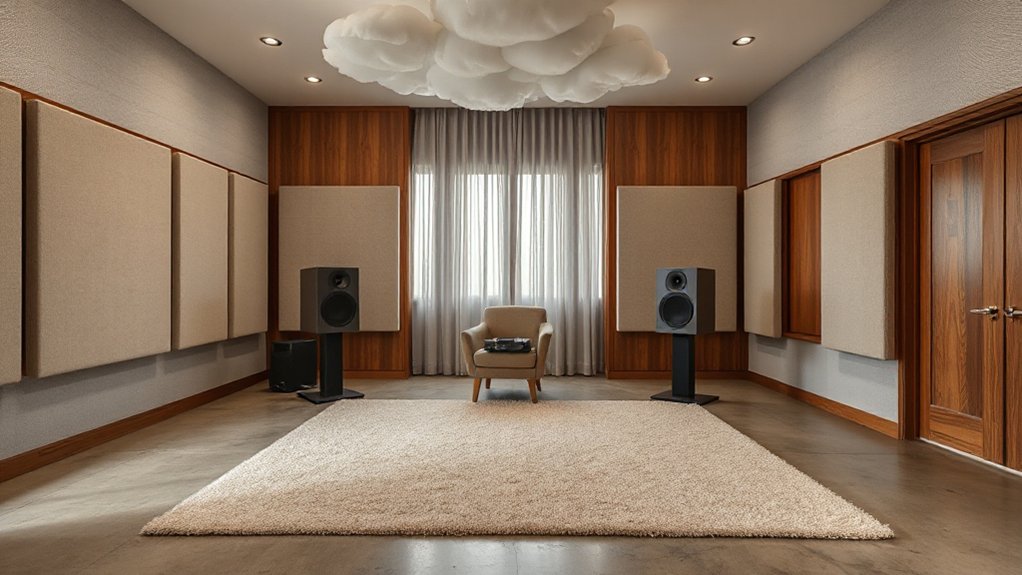
Before you buy treatment or run cable, lock down the room’s geometry and your listening position so the speakers can work with the space instead of fighting it. Aim for symmetry: center your seat on the room’s width, then place it about 38% of the room length from the front wall. Set speakers on the short wall, tweeters at ear height, forming an equilateral triangle with your head (typically 1.8–2.5 m sides). Start with speakers 0.6–1.0 m from the front wall and ≥0.5 m from side walls, then toe-in so axes cross just behind your head. Keep Furniture arrangement balanced: identical side clearances, no tall racks between speakers. Align Lighting design to avoid fixture buzz and keep dimmers outside the audio circuit.
Reduce Reflections With Acoustic Wall and Ceiling Panels
Once your listening position and speaker triangle are locked in, you can control what the room adds back by treating the first-reflection paths on the side walls and ceiling with broadband absorbers. Find these points with a mirror test, then cover each zone with panels at least 50–100 mm thick plus a 25–50 mm air gap to extend absorption downward. For Echo reduction, target mid/high energy: aim for NRC ≥0.85 or absorption coefficients α≥0.8 from 500 Hz to 4 kHz, where image shift and comb filtering are most audible. Material selection matters: choose rigid fiberglass or mineral wool (48–80 kg/m³) wrapped in breathable fabric; avoid plastic-faced finishes that reflect. Use a ceiling cloud centered over the listening area for tighter stereo focus.
Tighten Bass With Bass Traps and Vibration Control
Although broadband panels clean up imaging, low frequencies still pile up in the corners and along boundaries, so you’ll tighten bass by controlling room modes and structure-borne vibration. Start with corner bass traps: use 100–150 mm mineral wool (48–64 kg/m³) straddling corners with a 50–150 mm air gap to increase low-frequency absorption. If you’re fighting a narrow bass resonance, add tuned traps: membrane or Helmholtz units targeting your measured peak (for example, 50–80 Hz), placed at pressure maxima on front/back walls. Measure before/after with sine sweeps and aim for shorter decay (RT60) below 125 Hz. Control vibration with vibration isolation: decouple speakers using elastomer pads or spring isolators tuned below ~10 Hz, and use mass-loaded bases to reduce cabinet-rocking and floor excitation.
Block Noise Bleed With Sealed Doors, Windows, and Floors
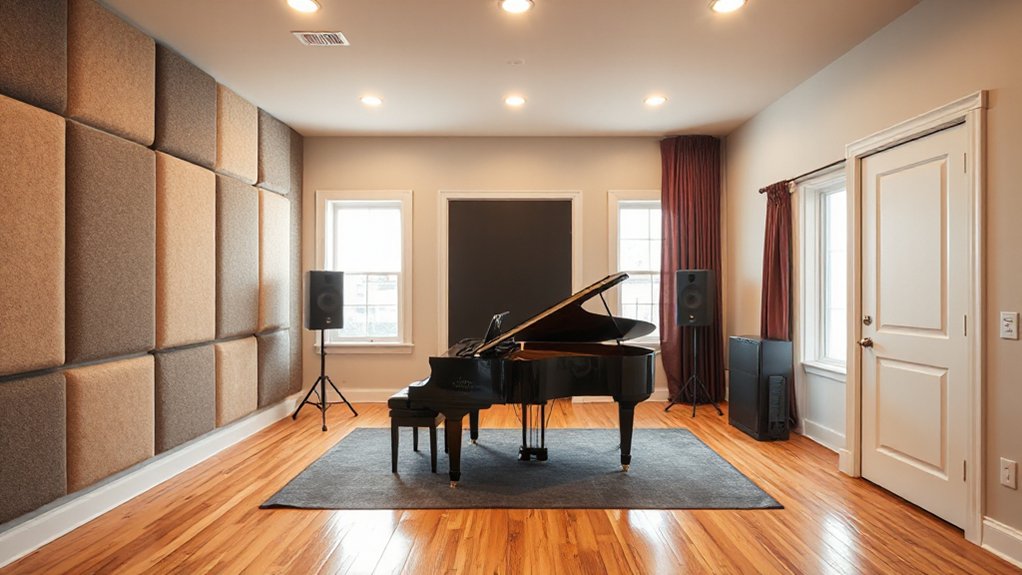
Clean bass inside the room won’t matter if sound leaks through the building envelope, so shift from internal modal control to isolation by sealing the weakest paths: doors, windows, and floor edges. Start with the door: use Door seals on all four sides plus an automatic drop seal; target <1 mm gaps, because a 1% leak area can cut isolation by ~10 dB. Choose a solid-core slab (≥45 kg) and add a second door for a 100–150 mm airlock if you need +10–15 dB. For windows, upgrade Window insulation with laminated double glazing (e.g., 6.4/12/4 mm) and caulk the frame perimeter with acoustical sealant. At floors, seal perimeter gaps and isolate thresholds with neoprene gaskets to stop flanking.
Frequently Asked Questions
What Budget Should I Plan for a Sound‑Optimised Music Room?
Plan $3,000–$15,000 for a sound‑optimised music room: $800–$3,000 Acoustic panels, $500–$2,500 Soundproof doors, $1,700–$9,500 isolation (mass, decoupling). You’ll hit STC 50–60 and RT60 0.3–0.6s.
Do I Need Permits or Approvals to Convert a Room Into a Music Room?
You’ll likely need permits if you modify walls, wiring, HVAC, or add mass; cosmetic changes usually don’t. Soundproof curtains and acoustic panels rarely trigger approval. Check local codes, HOA rules, and fire ratings.
Which HVAC Solutions Keep the Room Quiet Without Sacrificing Ventilation?
Use oversized, low-velocity ducts (<2.5 m/s), lined plenums, and duct silencers to cut Ventilation noise to NR25–30. Specify a variable-speed, remotely located air handler, add Acoustic treatments around grilles, and balance airflow precisely.
How Can I Manage Cable Routing and Power Safely for Audio Equipment?
Neat, labeled bundles beside isolated AC lines: you’ll route signal and mains separately. Use cable management trays, grommets, and Velcro; keep 150 mm separation. For power safety, you’ll use surge protection, GFCI, 20 A circuits.
What Lighting Choices Avoid Noise, Heat, and Unwanted Audio Interference?
Choose dimmable LED Lighting fixtures with remote drivers, flicker <1%, and EMI-rated shielding to prevent hum. Keep drivers 1–2 m from preamps, use twisted pairs. Prefer 2700–3500 K, <10 W/fixture heat. Acoustic treatments.
Conclusion
You’re like a navigator building a lighthouse for sound: you chart the room, set speakers on the 38% line, and lock in symmetry so imaging holds within ±1 dB. You tame early reflections with 50 mm panels at first‑reflection points and a ceiling cloud, cutting RT60 toward 0.2–0.4 s. You trap bass in 200–300 mm corners, decouple gear, and seal gaps to hit STC 45+. Now your music guides, not ghosts.
About the Author