
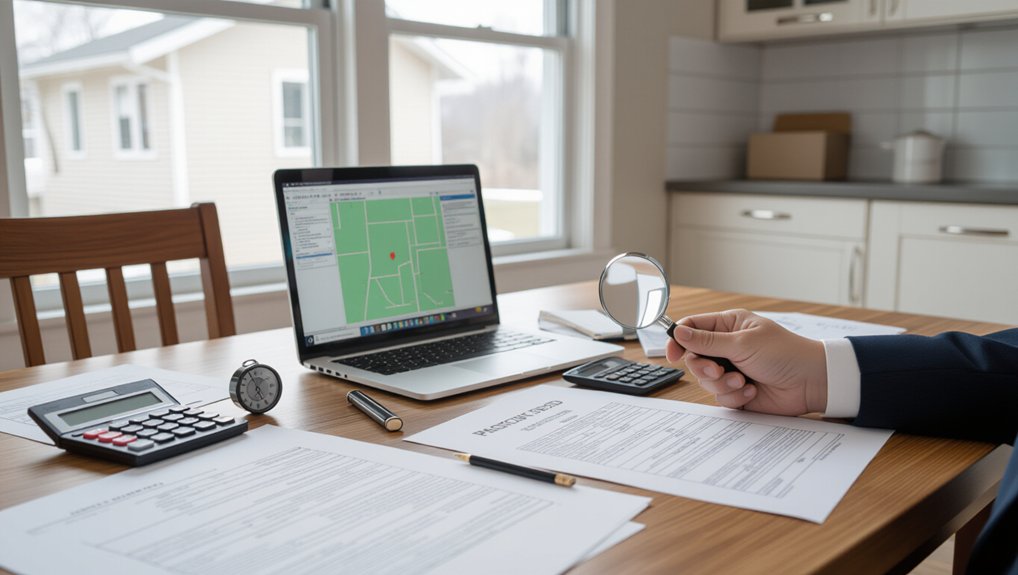
You avoid costly auction surprises by treating every property as a fixed-price, “as-is” deal and setting hard go/no-go gates before you bid. You confirm auction type, buyer’s premium (5%–12%), deposits, and payment windows, then run public-record checks for taxes, permits, and code violations. You order an early title search to surface liens and exceptions, verify occupancy and eviction timelines, and price repairs with a 10%–30% buffer. Next, you lock comps and your max bid—more safeguards follow.
Key Takeaways
- Identify the auction type, format, fees, deposits, and deadlines, then set a firm maximum bid including all costs.
- Use a pre-bid checklist: clear title, occupancy verified, rehab scope realistic, financing ready, and walk-away triggers defined.
- Run a title and lien search early, confirming ownership, legal description, unreleased mortgages, judgments, taxes, and HOA obligations.
- Estimate repairs “as-is” using verifiable system details, contractor quotes, unit costs, and a 10–30% risk buffer plus carry costs.
- Verify occupancy and eviction timelines, then validate ARV with nearby recent comps and conservative adjustments for condition and neighborhood risks.
Choose the Auction Type and Bidding Rules

Before you bid on an auction property, you’ll want to lock down the auction type and the exact bidding rules because they determine your pricing strategy, your financing options, and your failure risk. Identify whether it’s absolute, reserve, or minimum-bid; each shifts the probability of a no-sale and the likelihood you’ll overpay. Confirm the format: online timer resets, live outcry increments, sealed-bid deadlines, or hybrid “extended bidding.” Read the buyer’s premium (often 5%–12%), deposit amount, and payment window (24–72 hours is common), since these can force cash or hard-money. Map bid increments and starting bid to your ceiling to avoid anchoring effects. Account for bidding psychology: escalation, crowd signals, and last-minute sniping. Treat rules as constraints, not suggestions.
Use a Pre-Bid Checklist (Go/No-Go Fast)
Once you’ve confirmed the auction type and rules, run a pre-bid checklist that forces a fast go/no-go decision instead of a hopeful “maybe.” Set hard gates—clear title path (or acceptable liens), verified occupancy status, realistic repair scope with a contingency buffer, financing and cash-to-close timed to the auction’s deadline, and a maximum all-in price that includes buyer’s premium, transfer taxes, and immediate carrying costs—then walk away automatically if any gate fails. Quantify each gate: estimate days-to-possession, capex range, and monthly burn rate, then stress-test your numbers at +10–20% costs and +30 days delay. Use Auction strategies like pre-committed bid ceilings and scripted walk-away triggers to beat bidding psychology, avoid sunk-cost thinking, and prevent last-minute rule-bending. Document assumptions and require proof before bidding.
Pull Auction Property Public Records (Permits, Taxes)
Even if the auction packet looks complete, you should verify the property’s paper trail in public records to catch deal-killing liabilities early. Pull the tax assessor roll, treasurer payment history, and any delinquency notices to quantify back taxes, penalties, and redemption timelines. Check recorded assessed value changes against listing claims; sudden drops can flag damage, vacancy, or reclassification.
Next, review the building department’s permit history: issued permits, finals, expirations, and open violations. Unfinaled permits often signal unfinished work you’ll inherit; repeated electrical or structural permits can indicate chronic problems. Request inspection notes and code-enforcement logs to see what inspectors cited and whether fines accrue daily. Document dates, amounts, and required corrections before you set your max bid.
Run a Title Search and Lien Check Early

Run a title search early so you can confirm the current property owner matches the auction file and county records. You’ll also surface recorded liens—tax, HOA, judgment, or mechanic’s—that can survive the sale and change your true acquisition cost. Verify the title chain history for breaks, quitclaim gaps, or unreleased prior liens so you can quantify closing risk before you bid.
Identify Current Property Owner
Who actually owns the property you’re about to bid on—and what claims sit ahead of you in line? Start by confirming the deeded owner, not just the auction filer. Pull the latest recorded deed, verify vesting type (individual, trust, LLC), and match names against the auction case and mailing address. If ownership changed recently, flag it; rapid transfers can signal disputes or incomplete documentation that slows closing. Cross-check parcel IDs across assessor, recorder, and auction notices to prevent bidding on the wrong lot. Owner identity also drives your Property valuation: occupant status, transfer history, and arm’s-length indicators affect comps. Compare recent neighborhood sales and Market trends to spot overbids driven by hype. Document every source and date for auditability.
Check For Recorded Liens
Before you bid, you’ll want a lien picture that’s as current as the recorder’s index, because recorded claims determine whether your winning bid buys equity—or inherits debt. Run a preliminary title search and pull recorded Liens and encumbrances: mortgages, HELOCs, judgment liens, IRS liens, mechanic’s liens, HOA liens, and UCC filings tied to fixtures. Compare recording dates, amounts, and release status; an unreleased satisfaction can block resale or financing. Check for legal restrictions recorded against the parcel, such as easements, right-of-way dedications, deed restrictions, and pending lis pendens that signal active litigation. Then estimate exposure: prioritize senior liens, calculate payoff plus interest and fees, and add typical recording, title, and attorney costs to your maximum bid cap.
Verify Title Chain History
How far back should you trace ownership to feel confident your bid buys marketable title? Start with a 30–40 year title history, then extend further if you spot breaks, quitclaim deeds, probate transfers, or rapid resales. Order a preliminary title report and run ownership verification against county grantor-grantee indexes, tax assessor records, and recorded plat maps.
Flag gaps in the chain, unreleased mortgages, judgment liens, HOA liens, IRS notices, and municipal code enforcement filings. Confirm each conveyance matches legal descriptions, not just street addresses. Check for open estates, missing heirs, or powers of attorney that could be challenged. If the title report shows exceptions, price the cure: quiet title, releases, or endorsements—before auction day.
Confirm Occupancy, Access, and Eviction Timeline
Before you bid, you’ll verify whether the property is owner-occupied, tenant-occupied, or vacant by cross-checking county records, posted notices, and recent utility or mail indicators. You’ll also confirm access constraints—keys, lockouts, and inspection limits—because lack of entry can hide material defects and inflate your repair budget. If it’s occupied, you’ll map the eviction timeline and costs using local notice periods, court backlogs, and cash-for-keys assumptions so you can price the holding risk into your maximum bid.
Verify Occupant Status
Where do you stand if the property isn’t vacant on auction day? You need facts, not assumptions. Verify who’s inside by checking tax mailing addresses, utility account notes, and recent permit activity. Pull court dockets for unlawful detainer filings and scan recorded documents for leases, assignments, or notices. Confirm Lease status by requesting estoppels when possible and reviewing rent rolls, if provided, for payment history and concessions.
Assess Occupant behavior through observable signals: maintained yards, covered windows, security bars, or frequent police calls. Document access limits: are showings allowed, keys available, and are there “do not disturb” instructions? Price the risk with inspection uncertainty and potential damage exposure, then set a bid cap that reflects worst-case interior condition and delayed possession risk.
Plan Eviction Timeline
Exactly when can you take control after the gavel drops? Not immediately, in most cases. You must confirm whether the sale requires court confirmation, a redemption period, or a recorded deed before you can access the property. Request the sheriff’s sale terms, then map the fastest legal path to possession by date. If occupants remain, budget for formal notices, filing fees, and downtime. Eviction procedures vary by county, but timelines commonly run 30–90+ days, longer if service fails or hearings backlog. Don’t assume cash-for-keys will work; document every offer. Track Tenant rights, including notice periods, habitability claims, and protected-status defenses that can pause removal. Build a contingency schedule and carry costs into your bid cap.
Estimate “As-Is” Repair Costs and Risk Buffer
Even if an auction listing looks clean, you should treat the property as “as-is” and price repairs like you won’t get a second chance to renegotiate. Build renovation budgeting from verifiable line items: roof age, HVAC tonnage, water heater date, electrical panel amps, plumbing material, and visible foundation cracks. If you can’t inspect, assume worst-case for hidden systems and allocate accordingly. Get contractor estimates in writing for big-ticket trades, then validate with unit costs ($/sq ft for flooring, $/linear ft for sewer, $/square for shingles). Add a risk buffer: 10–15% for light rehab, 20–30% for heavy rehab, plus separate cash for permits, dumpsters, utility reconnects, and rekeying. Price time, too: carry costs accrue daily.
Research Neighborhood Comps to Set Your Price Cap
Before you bid, you need neighborhood comps that tell you what the property will realistically sell for after rehab, not what the auction hype suggests. Pull 3–6 closed sales within 0.5 miles from the last 90–180 days, matching bed/bath, square footage (±15%), lot, parking, and construction type. If inventory is thin, widen distance before you widen time. Adjust for condition: compare only renovated finishes if you’re underwriting a rehab. Track Market trends: days on market, sale-to-list ratio, and price-per-square-foot direction over the last two quarters. Then stress-test value by subtracting discounts for weak Neighborhood amenities, school ratings, noise, flood zones, or stigma. Your price cap is the conservative ARV, not the best comp.
Add All Auction Fees, Then Set Your Max Bid

Once you’ve set a conservative ARV from comps, you need to “all-in” your acquisition cost by stacking every auction fee on top of your bid—buyer’s premium, registration/deposit requirements, admin/technology fees, transfer taxes, title/closing fees, back taxes or HOA arrears (if they survive the sale), and any mandatory eviction or occupancy costs—then work backward to a hard max bid. Build a line-item sheet and convert each fee to dollars and percent of ARV so you can stress-test margins. If your target profit is 15% and repairs plus holding run 25%, your total basis can’t exceed 60% of ARV. Lock that number before auction day. Your Auction strategies should include an automatic stop-loss: don’t chase. Manage bidding psychology by preset increments and refusing “one more bid.”
Frequently Asked Questions
How Do I Secure Financing Fast Enough for an Auction Closing Deadline?
You secure fast financing by getting preapproved hard-money or bridge loans, confirming auction house procedures, and lining up proof of funds. You’ll use bidding strategies that match your cash-to-close, deadlines, and contingencies.
Can I Back Out if Post-Auction Inspections Reveal Major Defects?
You usually can’t back out—auction sales are a trapdoor. Unless you secured Inspection contingencies or prove defect disclosure violations, you’re bound. Expect earnest money loss and legal costs; review terms, state law, and deadlines fast.
What Insurance Coverage Do I Need Immediately After Winning the Bid?
You need coverage at bid acceptance: bind hazard/dwelling and liability now. Meet lender Coverage requirements: replacement cost, loss payee, deductible limits. Compare Insurance options: vacant-property, builder’s risk if repairs, flood/earthquake where mapped.
How Are Utilities Transferred or Restored After Purchasing at Auction?
You’ll contact each provider right after closing, request a utility transfer, and schedule reconnection. But first, picture dark rooms—verify account holds, unpaid balances, meter status. Document IDs, deed, and follow their restoration process timelines.
What Are Common Tax Implications of Buying and Reselling Auction Properties?
You’ll face capital gains on resale profit, taxed short- or long-term, plus possible transfer taxes and property taxes during holding. Track basis, rehab costs, and Tax deductions. Underestimate timelines, and you’ll trigger higher rates.
Conclusion
If you don’t research auction properties like a forensic analyst, you’re bidding blind. One study found distressed homes can need 15%–20% more in repairs** than expected, and that gap can erase your profit fast. You’ll cut risk by locking in the auction rules, verifying permits and taxes, running title and lien checks early, confirming occupancy, and pricing repairs with a buffer. Add every fee, then set a hard max bid**—and stick to it.
About the Author