
To buy a repossessed property at auction without overspending, you’ll pick the auction format that fits your risk, then use the notice period to verify timelines, occupancy, and redemption rights. You’ll set a hard maximum bid from 3–6 recent sold comps within 0.5–1 mile, then subtract repairs, holding, and a 10%–15% contingency. You’ll add buyer’s premium, taxes, legal/title costs, and lien risk to your cap, and you won’t bid past it. Next, you’ll tighten your plan further.
Key Takeaways
- Choose an auction format that fits your risk tolerance, and follow its rules on timing, increments, deposits, and deadlines.
- Set a hard maximum bid using worst-case all-in costs, including rehab, holding, fees, and a 10–15% contingency.
- Base value on 3–6 nearby sold comps from the last 3–6 months, adjusting for condition, size, and features.
- Research title, liens, taxes, redemption rights, and occupancy before bidding to avoid inheriting costly legal or possession problems.
- Budget closing costs and surprise expenses like utilities, code violations, permits, and municipal fines, and cap your bid accordingly.
Pick the Right Repossessed Auction Format

Before you set a budget or book a viewing, you’ll save the most money by choosing an auction format that matches the level of competition and risk you can manage. If you’re price-sensitive, target low-attendance local room auctions where comparable sales data shows wider spreads between guide and hammer prices. If you need transparency, choose online timed auctions: you can track bid velocity, set hard ceilings, and avoid adrenaline-driven overshoots. If you’re confident in underwriting, consider sealed-bid formats; they reduce “auction fever” but punish weak pricing models because you don’t get feedback from rival bids. Align auction strategies to your edge: speed, data, or discretion. Then tailor bidding tactics—early anchoring, late sniping, or fixed increments—to the chosen format.
How Repossessed Auctions Work (Steps + Deadlines)
You’ll start by tracking the auction timeline: notice dates, inspection windows, and the published terms that set your hard cutoff points. Next, you’ll register, verify bidder requirements, and line up the deposit amount and payment method so you can bid without last-minute friction. After the hammer falls, you’ll manage post-auction deadlines—deposit confirmation, contract signing, and a tight closing window (often 14–30 days)—so you don’t lose the property or pay penalties.
Auction Timeline And Notices
Although each lender and county sets its own procedures, repossessed-property auctions generally follow a predictable timeline. First, you’ll see a Notice of Default or Lis Pendens recorded, then a Notice of Sale published and posted. Many jurisdictions require 3–4 consecutive weeks of newspaper publication and on-site posting 15–30 days before the sale; confirm exact statutory lead times in your county clerk’s docket. Track the case number weekly because postponements and cancellations are common, often announced 24–72 hours before the scheduled date. Your auction strategy should treat the notice period as your research window: verify legal description, senior liens, redemption rights, and occupancy. Bidder psychology shifts late—scarcity headlines spike competition—so rely on docket facts, not chatter.
Registration, Deposits, And Bids
Once the Notice of Sale posts, the clock shifts from research to execution: you’ve got to register correctly, bring the right deposit, and follow the bid rules exactly or you’ll forfeit your seat at the sale. Confirm the Registration process early: deadlines can be 24–72 hours pre-auction, and ID, W-9, and bidder forms must match your bidding entity. Ask whether you must pre-register online, in person, or both, and verify bidder-number pickup times.
Meet Deposit requirements precisely: many sales demand a cashier’s check or wire for 5%–10% of the opening bid, with strict payee wording and no personal checks. At the podium, bid in preset increments, track your max, and stop when the spread exceeds your margin buffer.
Post-Auction Deadlines And Closing
After the hammer drops, the deal moves on a fixed clock: you’ll typically sign the memorandum of sale immediately, increase your deposit to the required total (often 10%–20%) the same day, and face a tight balance-due window—commonly 24–72 hours for some repossessed/REO-style auctions or 15–30 days for others, depending on the platform and seller. Confirm funds transfer cutoffs, wire instructions, and default penalties (often deposit forfeiture plus fees). Schedule Post auction inspections only if allowed; many sales are “as-is,” so focus on access dates, utilities, and occupancy status. Start title work within 24 hours: order a search, verify liens, and line up insurance. Your Closing procedures should prioritize speed—pre-book escrow/solicitor, prepare notarized IDs, and confirm prorations, taxes, and HOA dues. Miss deadlines, and you’ll lose leverage and money.
Set Your Hard Maximum Bid (Ceiling)
Before you ever lift your paddle or click “bid,” calculate a hard maximum bid that you won’t exceed, based on numbers—not emotion. Build it from the top down: your target all-in cost minus required profit cushion. Start with your exit price assumption, then subtract estimated rehab, holding costs (taxes, insurance, utilities, interest), transaction costs (auction premium, closing fees), and a contingency (typically 10–15% of rehab). Add your minimum return threshold to keep risk priced in. Use pricing strategies and market analysis to stress-test assumptions: run best/base/worst scenarios, and set the ceiling at the worst-case break-even minus your profit requirement. Write the number down, bring it, and stop bidding when you hit it.
Check Local Sold Comps to Find Market Value
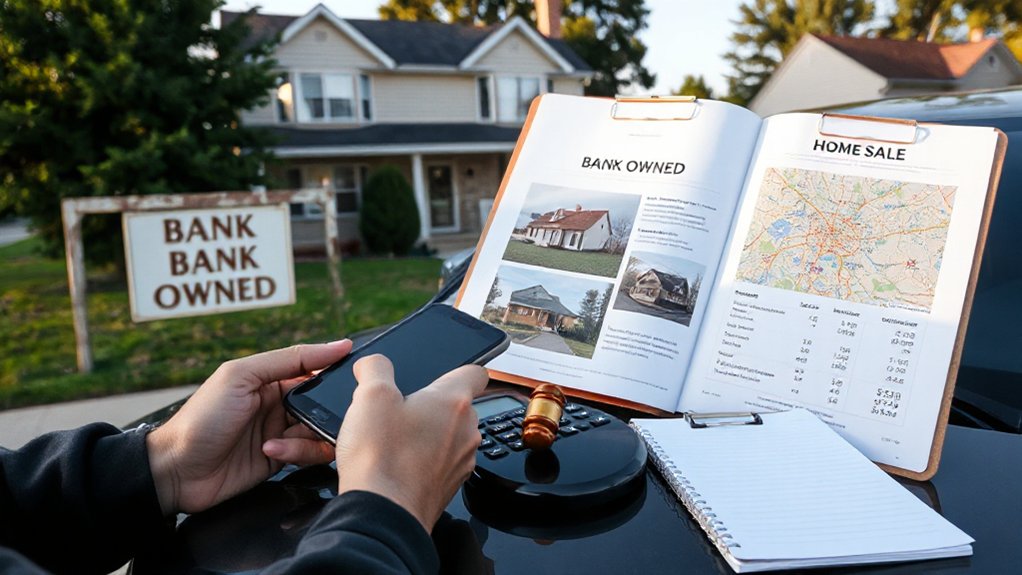
Although the auction listing might hint at “market value,” you should anchor your bid to what similar properties actually sold for nearby, not what sellers hope they’ll fetch. Pull 3–6 closed sales within 0.5–1 mile from the last 3–6 months, matching bed/bath count, square footage, lot size, and build year. In your Market analysis, adjust comps for condition and features: add/subtract for renovated kitchens, roof age, parking, view, and square-foot differences (use $/sq ft from the comp set). Exclude outliers like estate sales or fully remodeled flips if your target needs work. Then triangulate a tight value range (low/median/high) and use valuation strategies to keep your bid at or below the low-to-median band under auction pressure.
Add Fees, Taxes, and Legal Costs to the Total
Before you set your max bid, you’ve got to build an all-in cost model that adds auction fees and buyer’s premiums to the hammer price. Then you’ll factor in outstanding property taxes, HOA balances, and recorded liens that can survive the sale and hit your budget on day one. Finally, you’ll budget legal and closing costs—title search, insurance, eviction filings, recording fees—so your numbers stay accurate and you don’t overpay.
Auction Fees And Premiums
A winning bid rarely reflects your true all-in cost, so you need to price in auction-specific charges from the start: buyer’s premium (often 5%–10% of the hammer price), admin/registration fees, and required deposits, plus transfer taxes, title/recording fees, and any outstanding liens or municipal charges that survive the sale. Convert each fee into dollars and add it to your max bid ceiling before you enter the room. If the premium is 10%, a $220,000 hammer price becomes $242,000 instantly; a $1,500 admin fee pushes it higher. Use auction strategies like setting a “total-cost” cap and preloading fees into your bid increments. Manage bidding psychology by pausing after each bid and ignoring anchoring to the opening price.“`
Property Taxes And Liens
Even if the auction advertises a “clean” sale, you can still inherit costs that attach to the property, not the borrower—so you’ve got to audit taxes and liens like line items in your bid model. Pull the latest property tax assessment and verify delinquent amounts, penalties, and interest through the county treasurer. Then estimate the next billing cycle so you don’t underwrite using last year’s numbers. Next, map lien priority: property taxes usually sit first, while HOA, utility, or municipal liens may survive depending on statute and sale type. Request a payoff ledger where possible, and price each lien at full balance plus accruals. Subtract that total from your maximum bid so your all-in basis stays inside target returns.
Legal And Closing Costs
Taxes and liens set your baseline, but legal and closing costs often decide whether your “discount” purchase still pencils. Before bidding, itemize every line: auctioneer/buyer premium (often 5%–10%), recording and transfer taxes, escrow or settlement fees, and courier/notary charges. If the sale requires immediate cash or hard money, add points, origination, and per-diem interest for any delayed closing.
Budget for Legal documentation: a foreclosure deed review, HOA estoppel, and payoff statements can prevent surprise balances. Don’t skip Title insurance; repossessions can carry unreleased liens or boundary issues, and a policy plus a title search is cheaper than curing defects later. Build a closing-cost reserve—typically 2%–5% of price—then cap your max bid accordingly.
Estimate Repairs, Utilities, and Surprise Costs
Because repossessed homes often sit vacant and maintenance gets deferred, you should budget repairs and carrying costs before you set your max bid—using a line-item estimate rather than a percentage guess. Start with roof, HVAC, plumbing, electrical, windows, and moisture; price each using local per-unit rates (e.g., $6–$10/sq ft for roofing, $4k–$9k for HVAC). Add permits, dumpsters, and a 10% contingency for hidden damage. For renovation budgeting, separate “must-fix for occupancy” from “value-add” so you don’t overpay for upgrades. For utility planning, assume reconnect fees, deposits, and 30–60 days of power/water for dry-out, testing, and contractor work. Include lawn, winterization, insurance, and security to prevent repeat vandalism.
Check Title, Liens, Tenants, and Possession Risk

Before you bid, run a possession-and-title risk check so you don’t inherit costs that erase your margin. Order Title searches covering at least 10–20 years to spot mortgages, judgments, unpaid taxes, HOA arrears, and mechanic’s liens that may survive the sale. Confirm redemption periods, notice defects, and whether the auction conveys “as-is, where-is” with limited warranties. Pull the occupancy status from listings, utilities, or a drive-by, then verify lease terms, rent rolls, and local tenant rights. If tenants are protected, model holdover time, cash-for-keys, or court timelines, and price that delay into your maximum bid. Also check for code violations, permits, and municipal fines that can attach to the property post-closing.
Get Financing and Deposits Ready Before Auction Day
Title and possession checks tell you what you’re buying; financing readiness determines whether you can actually close and at what cost. Line up financing options early: cash, bridge loans, hard money, or a pre-approved mortgage that allows auction purchases. Ask lenders for written terms: max loan-to-value, rate range, points, required appraisal, and underwriting timeline, then map them to the auction’s settlement deadline (often 28–45 days). Stress-test payments using conservative rent and vacancy assumptions, and include insurance, taxes, and HOA dues. For deposit strategies, confirm the exact deposit amount (commonly 5%–10%) and acceptable forms (bank draft, cashier’s check, card). Pre-stage funds in a same-day-access account and bring backup instruments to avoid default fees.
Use a Bidding Plan to Avoid Paying Too Much
Even if you’ve got financing lined up, you can still blow your returns in 90 seconds if you bid without a ceiling. Set a maximum based on after-repair value (ARV) minus repairs, fees, and your target profit. Add line items for buyer’s premium, taxes, eviction risk, and utility arrears so your cap reflects true all-in cost.
Walk in with three numbers: opening bid, walk-away price, and a “one more bid” increment (for example, 1% of cap). Use competitive bidding rules: don’t chase; counter only when the next bid stays within your modeled margin. Preselect auction strategies—early assertive bids or late entry—based on attendance and comparable sales, not emotion. If the room breaks your cap, stop instantly.
Frequently Asked Questions
What’s the Difference Between Repossessed, Foreclosed, and Bank-Owned Properties?
Repossessed means a lender takes back a property after default; foreclosed means the legal process to sell it; bank-owned (REO) means it didn’t sell at auction. Use Property valuation and Auction registration to control bids.
Can I Visit the Property Interior Before Bidding at a Repossessed Auction?
Usually you can’t visit the interior before bidding; auctions often limit Interior inspection. You should request a Property viewing through the agent, review occupancy status, and price bids assuming unseen defects and repair contingencies.
Are Repossessed Auction Properties Sold “As-Is” With No Seller Disclosures?
Yes, you’ll usually buy repossessed auction properties as-is with minimal or no disclosures. You should prioritize Property inspection, review title and liens, then price unknown repairs into your Bid process with strict maximums.
Can I Bid Through an Agent or Must I Bid Personally?
Measure twice, cut once: you can bid through agent bidding or personal bidding, but rules vary. You’ll sign a bidder agreement, provide ID and deposits, and set firm caps so your agent can’t exceed limits.
What Happens if I Win but Cannot Complete the Purchase on Time?
If you win and can’t close on time, you’ll forfeit your deposit, face penalties, and risk resale claims under legal obligations. You should pre-arrange auction financing, confirm timelines, and set contingency buffers to reduce default risk.
Conclusion
If you want a repossessed property bargain, you can’t “wing it”—that’s a million-mile shortcut to overspending. Pick the right auction format, lock in your hard bid ceiling, and validate value with sold comps, not list prices. Then total every line item: buyer’s premium, taxes, legal fees, insurance, utilities, and repair contingencies. Clear title and possession risks early, and secure financing and deposits upfront. Show up with a bidding plan—and stick to it.
About the Author