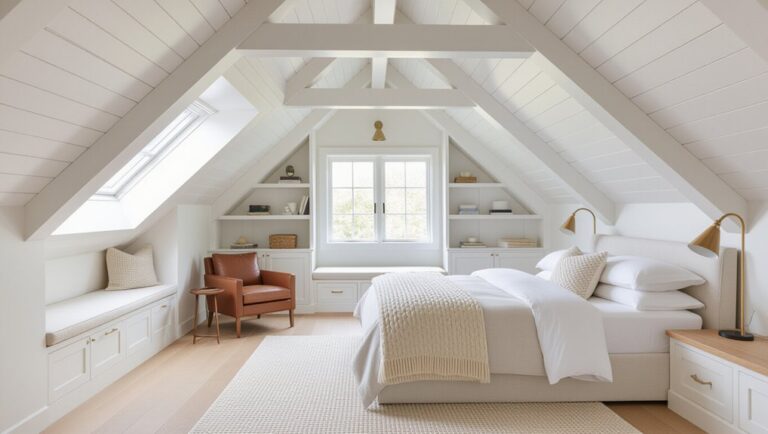

You’ll brighten a dim loft by shaping roof openings first: add high, roof-plane skylights between rafters for deep, diffuse top light, or build dormers for vertical glazing, views, ventilation, and full-height headroom. Check planning limits, structure, and insulation/airtightness early, and use low‑U, low‑E glazing with proper flashing. Plan circulation and work/seating inside daylight cones, keep partitions low, and boost reflectance with high‑LRV finishes. Next, you’ll refine privacy, glare, and airflow.
Key Takeaways
- Use roof-plane skylights for diffuse top light; add dormers where headroom and vertical glazing improve views and ventilation.
- Position openings high on the roof slope and over circulation/task zones to push daylight deeper and reduce glare.
- Specify high-performance low‑E glazing with airtight, insulated roof build-ups and flashing kits to prevent heat loss and leaks.
- Boost brightness with high‑LRV ceilings and walls, and keep partitions low or permeable so light can wash across the loft.
- Control comfort with layered shading, privacy glazing where needed, and venting units to manage heat buildup and airflow.
Choose the Best Way to Brighten Your Loft (Skylight vs Dormer)
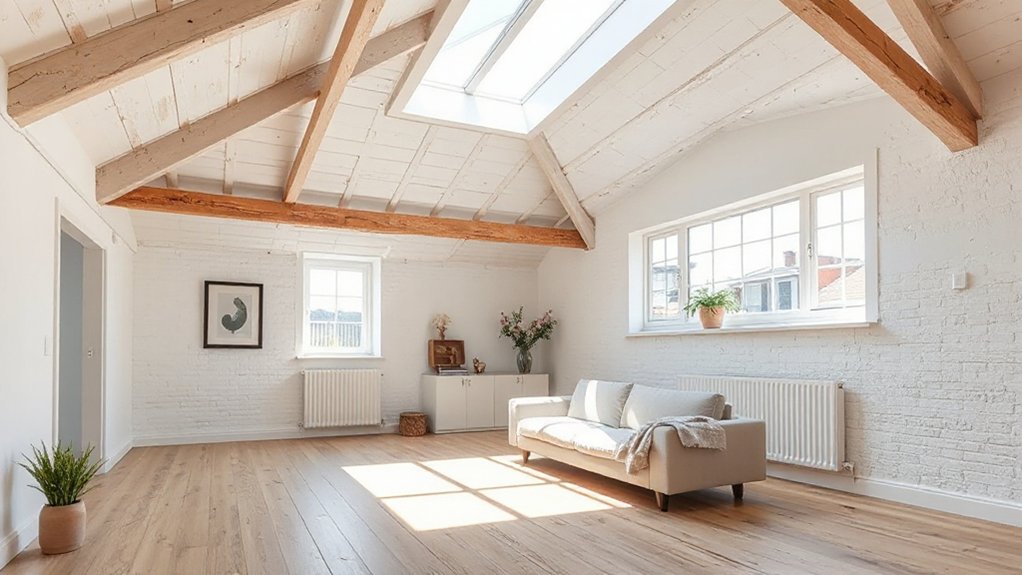
If you’re trying to pull more daylight into a loft, start by deciding whether a roof‑plane skylight or a dormer best matches your roof geometry and usable floor area. A skylight sits flush to the slope, so you keep rafters largely intact, gain high-angle light, and preserve exterior massing; place it between structural members and align it with circulation so glare doesn’t hit eye level. A dormer projects outward, widening headroom at the perimeter and letting you use vertical glazing for more even luminance at seating height; it can also frame views and ventilation. Detail both options with continuous Loft insulation around the opening, airtight membranes, and low‑U glazing to protect energy efficiency and avoid cold-bridge condensation.
Check Planning Rules and Roof Constraints Early
Before you cut a hole in the roof, confirm what planning controls and physical roof constraints will actually let you build. Check permitted-development limits, conservation overlays, party-wall notices, and any ridge-height or volume caps that could force a lower profile. Measure headroom from finished floor to underside of rafters, then map chimney stacks, purlins, collars, and truss webs that will block circulation and furniture zones.
Next, verify load paths: existing joists rarely meet habitable-floor deflection limits, so plan Structural reinforcement with new beams or sistered members tied into bearing walls. Confirm rafter depth for insulation techniques that hit U-values without stealing clearance; you may need over-rafter build-ups or rigid boards plus a ventilated void. Finally, locate services and escape routes early to avoid rework.
Add Loft Skylights for the Biggest Daylight Boost
You’ll get the biggest daylight jump by choosing a skylight type that matches your roof build-up and span—fixed for pure light, venting for stack-effect purge, or a roof window if you need reach and egress. Place the opening between rafters where it can pull light deep into the floor plate, and align it with key zones like the stair landing, work area, or seating edge to reduce shadow bands. Use orientation, shaft depth, and reveal angles to control glare and spread light laterally across the loft.
Choosing The Right Skylight
While a loft conversion can borrow light from dormers and gable windows, a well-placed skylight delivers the biggest daylight boost because it pulls sky exposure from the roof plane itself. Choose a unit by performance class first: specify low‑E, argon-filled glazing, warm-edge spacers, and a U-value that matches your roof build-up. If you’ll open it, pick a top-hung or center-pivot sash sized for safe reach and effective Natural ventilation, and add insect screening. In rain-prone climates, select integrated flashing kits and an underlay collar compatible with your roofing type and pitch. For comfort, require laminated inner panes for Acoustic insulation and impact safety. Finish with a deep, splayed reveal lining to widen the light aperture without compromising insulation continuity.
Placement For Maximum Light
Because the roof plane “sees” the sky more directly than any dormer wall, skylight placement determines whether your loft reads as evenly daylit or patchy and glare-prone. Set units high on the slope to capture diffuse sky, not just horizon sun, and space them to overlap light cones across circulation paths. Align skylight centers with the room’s working zone, not the eaves, and keep headers clear of ridge beams and purlins so you don’t force compromised sizes. On south exposures, shift openings slightly north of the ridge line or add exterior shades to cut noon glare. Coordinate Furniture arrangement so desks and seating sit perpendicular to light, avoiding screen reflections. Pair shafts with matte reveals and Acoustic treatment panels to dampen rain noise and reduce brightness contrast.
Use Dormer Windows to Add Light and Headroom
You’ll get the most value from a dormer when you place it where the roof slope pinches circulation—over the stair landing, along the primary seating zone, or centered on the room’s longest sightline. You’re not just adding glass; you’re shifting the knee wall outward to create full‑height headroom, so align the dormer width and sill height to your furniture layout and required clearances. With the right orientation and operable sash, you’ll boost daylight penetration and set up cross‑ventilation that flushes hot air at the loft’s highest point.
Dormer Placement Strategies
If your loft feels bright but unusable at the edges, dormer placement fixes both the daylighting and the headroom geometry in one move. Start by mapping your primary use zones—desk, reading chair, or stair landing—then align the dormer centerline to those task areas so the window washes the floor, not just the rafters. Keep the dormer face square to the best view and sun angle, but respect roof slope considerations so the dormer roof drains cleanly and meets the existing planes without awkward valleys. Place dormers symmetrically on the street side if required, or cluster them on the rear for freer massing. Maintain clear separation from ridge and hips to preserve structural continuity and simplify flashing paths.
Maximizing Headroom Gains
Where does the ceiling pinch your layout—right at the bed edge, along the circulation line, or over the desk? Set the dormer to intercept that low-slope zone and convert unusable eaves into standing area. You’ll gain the most when the dormer face aligns with the primary headroom threshold (often the 2.0 m line) and runs long enough to cover movement paths, not just a single point.
Detail the structure so it actually yields clearance: raise the dormer cheek framing above the existing rafters, specify a flush ridge tie-in, and keep the floor build-up thin. Coordinate Loft insulation thickness at cheeks and roof to avoid encroaching on the interior section, and match Roofing materials at abutments to maintain weathering lines and flashing depth.
Daylight And Ventilation Benefits
How does a dormer change a loft from dim and stuffy to bright and usable? You introduce a vertical window plane that captures higher-angle daylight and pushes it deeper across the floor, reducing harsh roof-slope shadows. With a properly sized opening, you can hit target daylight factors at desk height and make circulation zones legible. The added headroom lets you place seating or a worktop directly under the glazing without ducking.
For ventilation, you pair the dormer’s operable sash with a rooflight or stairwell opening to create cross-ventilation. Warm air exits high, cooler air pulls in low, producing Natural airflow without mechanical noise. That steadier air exchange supports Indoor greenery near the sill and limits condensation on cold mornings.
Plan the Loft Layout Around Window Light and Views
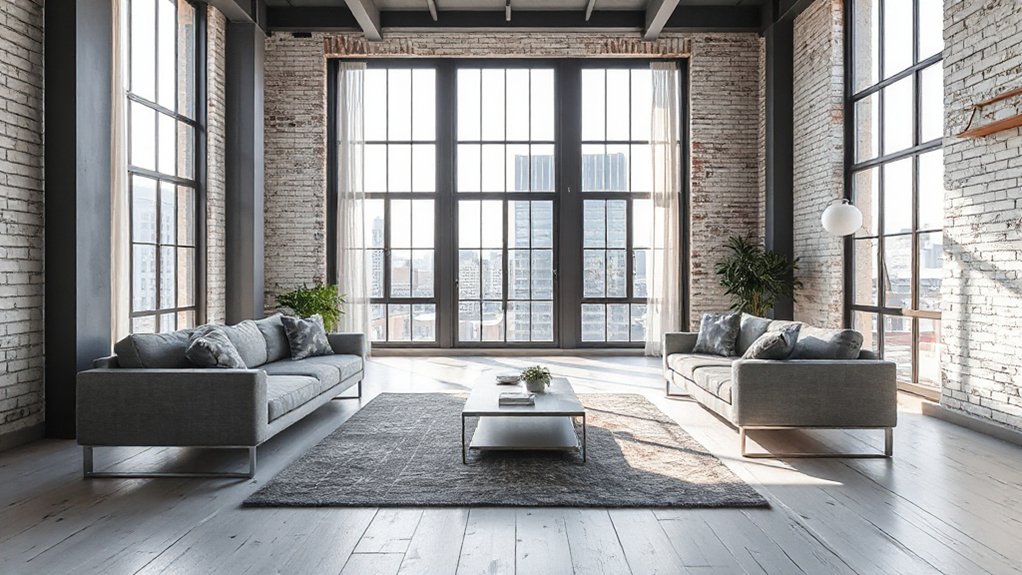
Although the loft’s footprint might feel flexible, your window light and sightlines should lock in the layout first. Stand at each roof window and map the sun path; place the primary seating zone where glare stays lateral, not head‑on. Align circulation parallel to glazing so you don’t block views with tall storage or partitions. Set a worktop or reading bench within the daylight cone, then push services—bathroom, mechanicals, closets—into the dimmer eaves. Keep the ridge line visually open by limiting full‑height walls to structural bays. Coordinate Structural reinforcement early so new beams don’t bisect the glazing axis. After framing, detail Loft insulation thickness at rafters and knee walls, preserving reveal depth so window wells still bounce light deep into the room.
Choose Privacy Glass and Blinds Without Losing Daylight
If you need privacy in a loft without flattening the light, specify the glazing and shading system as a single optical stack. Start with privacy glass that diffuses at eye level but stays high-transmission: consider acid-etched, micro-structured, or gradient interlayers so the upper zone remains clear for sky luminance. Keep visible transmittance (VT) and haze in balance; too much haze kills contrast and depth. Add interior window blinds with a light-colored, matte slat finish, and mount them tight to the frame to reduce edge leaks. Choose top-down/bottom-up operation so you block sightlines while preserving the daylight aperture. If you’ve got south or west exposure, use dual fabrics: sheer for daytime, opaque for night. Size headrails to clear trim.
Use High-LRV Paints and Light-Reflective Finishes
Because lofts pull daylight from a limited set of apertures, you’ll get a bigger perceived brightness jump by tuning surface reflectance than by adding another fixture. Choose wall and ceiling coatings with a high LRV (85+ for ceilings, 70–85 for walls) to push light deeper past beams and sloped planes. Specify Eco friendly paints with low-VOC binders and titanium dioxide for strong diffuse reflectance without glare. On trim and built-ins, use a satin enamel to raise specular return while keeping fingerprints manageable. Add Reflective wall finishes selectively—limewash with mica, pearlescent topcoats, or micro-matte lacquer—on the window-adjacent return wall and the end wall opposite the glazing. Keep floors mid-tone and matte so you don’t create harsh bounce or hotspots.
Add Storage and Partitions That Won’t Block the Windows
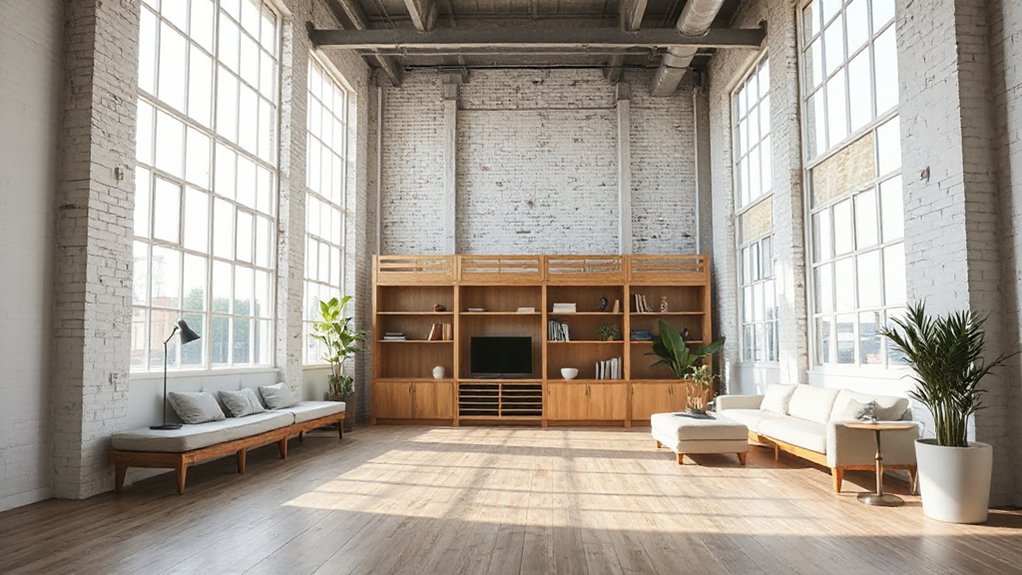
To keep daylight moving through a loft, you’ll want storage and partitions that sit below the window head height and preserve clear sightlines across the glazing. Run low millwork along the perimeter as a continuous datum, aligning tops with sill height so light washes over and into the room. Specify open-backed shelving or perforated panels where you need separation without a hard visual stop.
Use Multi functional furniture to replace bulky casework: a banquette with lift-up seats, an ottoman with drawers, or a platform bed with pull-outs. Build Hidden storage into knee walls and under eaves, with flush doors and touch latches to keep planes clean. If you need privacy, set a half-height partition perpendicular to the windows to maintain a clear daylight path.
Control Heat and Glare With Shading and Ventilation
Low partitions and perimeter millwork keep the glazing visually open, but the added daylight can also amplify heat gain and harsh contrast at peak sun. You’ll tame it by layering Smart shading: ceiling-recessed roller shades for full-height coverage, plus interior light-shelves or micro-louvers to cut high-angle glare while preserving view. Specify dual-opacity fabrics—3–5% open for daytime, blackout at media or sleep zones—and tie them to solar sensors and time-of-day scenes.
For cooling, you’ll prioritize natural ventilation with a clear airflow path: operable clerestories or awning vents high on the facade, paired with low inlets near the core. Use cross-vent alignment around partitions, add a quiet exhaust at the stairwell, and keep shade pockets airtight to prevent drafts.
Frequently Asked Questions
What Is the Typical Timeline for a Loft Daylight Conversion Project?
You’ll typically finish a loft daylight conversion in 6–12 weeks, depending on permits and lead times. You’ll schedule Structural reinforcement early, then frame apertures, run services, install Loft insulation, drywall, trim, inspections.
How Much Does a Skylight or Dormer Installation Usually Cost?
You’ll typically pay $1,500–$5,000 for a skylight, or $10,000–$30,000+ for a dormer—because roofs love surprise invoices. Factor cost considerations, installation challenges: structural framing, flashing continuity, insulation depth, interior shaft geometry, permits.
Will My Home Insurance Premium Change After Converting the Loft?
Yes, your premium can change after a loft conversion; you’ll likely pay more if you add habitable square footage, electrical loads, or stairs. Document loft insulation and roof repairs; insurers may discount reduced risk.
Do I Need to Upgrade Electrics or Heating for a Loft Living Space?
You’ll likely need Electrical upgrades and Heating considerations to meet code and comfort. You must size circuits for added loads, fit RCD/AFDD protection, and extend radiators or add zoned underfloor, matching insulation and airflow paths.
How Can I Soundproof the Loft From Rain and Outside Noise?
You’ll soundproof the loft by decoupling rafters with resilient channels, sealing junctions, and adding dense insulation between joists. Apply soundproofing techniques using noise reduction materials: mass-loaded vinyl, acoustic plasterboard, underlay, and sealed roof vents.
Conclusion
Once you’ve balanced skylights and dormers, your loft stops feeling like a roof void and starts reading as a bright, usable volume. You’ll watch a clean shaft of daylight slide across the floor plane, bounce off high‑LRV walls, and soften into corners that used to stay dim. With glazing, blinds, and ventilation tuned, heat and glare stay controlled. Storage sits below sills, partitions stop short of windows, and every view line stays open.
About the Author