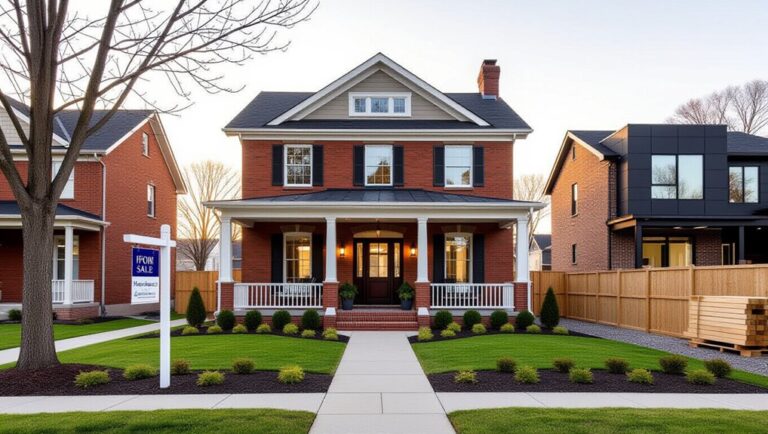
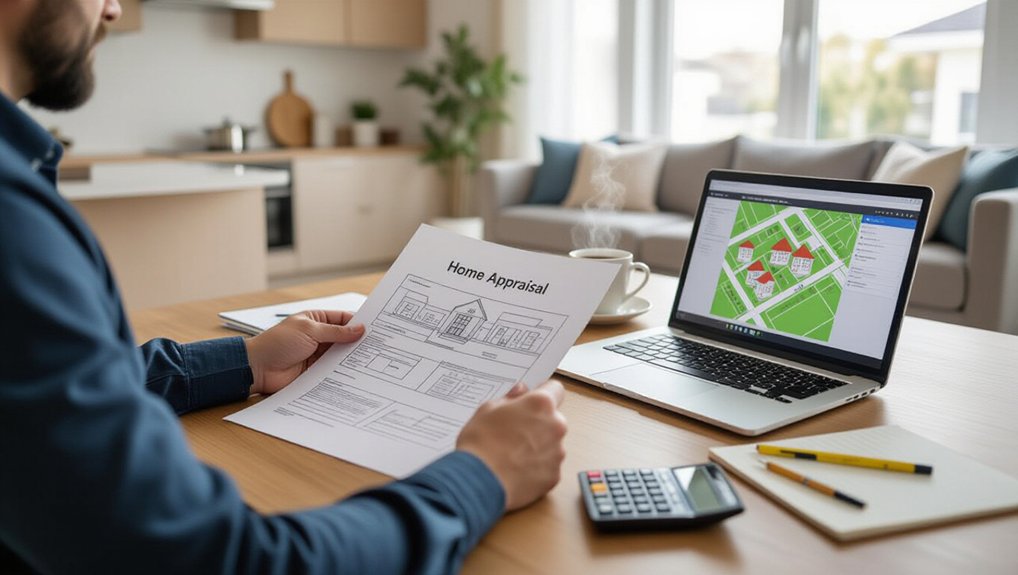
You’ll value your property accurately by pulling 3–5 nearby sold comps from the last 3–6 months and logging price, DOM, concessions, and financing. Adjust for size using price per square foot, then refine for beds, baths, lot, garage, and amenities with paired-sales logic and time adjustments. Walk the home to price must-fix repairs and validate upgrades with permit history and recapture rates. Sanity-check against 3+ online estimates, then align with inventory, DOM trends, and active listings; more tactics follow.
Key Takeaways
- Pull 3–5 recent sold comps within 3–6 months nearby, noting sale price, DOM, concessions, and financing type.
- Adjust comps for square footage, bed/bath count, lot size, and key amenities using price-per-square-foot and paired sales comparisons.
- Evaluate condition and upgrades, estimate repair costs with bids or unit costs, and subtract “must-fix” issues from your value range.
- Check local market signals—inventory months, median DOM, and price trends—to choose conservative or aggressive pricing within your comp range.
- Compare at least three online value estimates, correct property details, and use them only as a cross-check against your CMA.
Start With Comparable Sales (Sold Comps)
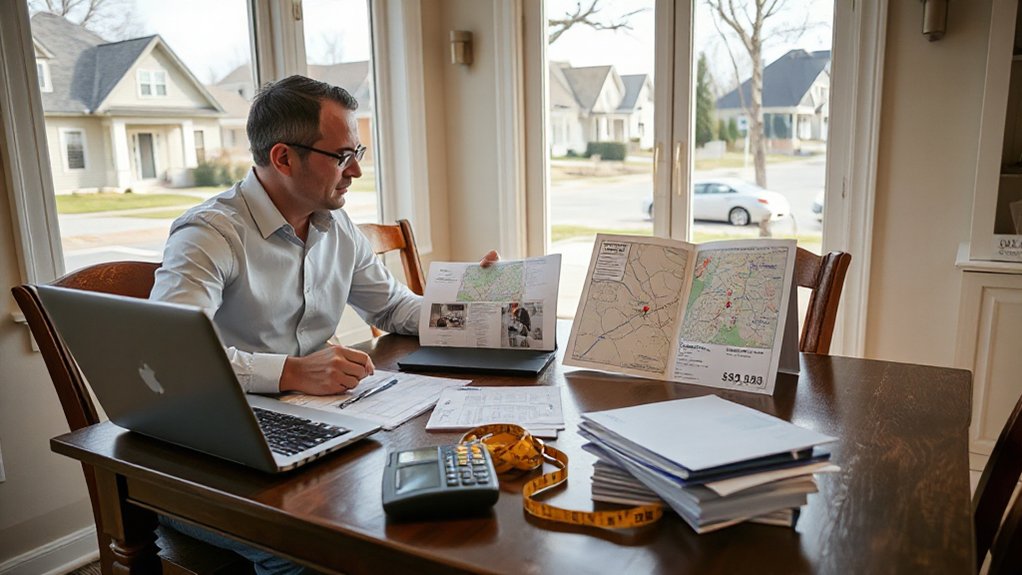
Because buyers and appraisers anchor value to recent, verified transactions, you should start your pricing work with comparable sales—“sold comps”—rather than active listings. Pull comps from the last 3–6 months, prioritizing closed sales within your immediate area and the same school zone or subdivision. Use at least 3–5 sales, and record sale price, list-to-sale ratio, days on market, concessions, and financing type. Then run quick Market trends checks: median sale price direction, inventory level, and average days on market month over month. Follow with Neighborhood analysis: boundaries that shift demand, proximity to nuisances or amenities, and whether sales cluster on certain blocks. If you can’t find enough nearby closings, expand cautiously by distance, then time.
Adjust Comparable Sales for Size and Features
Once you’ve gathered 3–5 strong sold comps, you need to normalize them so you’re not comparing unlike properties. Start by adjusting for size: compute each comp’s price per square foot, then apply it to your home’s living area to estimate a baseline. If a comp is larger, subtract the incremental value of the extra square footage; if smaller, add it. Next, adjust for measurable features that buyers price consistently in your market, such as bedroom/bath count, garage spaces, lot size, and key amenities like a pool. Use paired sales when possible to quantify each feature’s contribution, not guesses. Finally, align numbers with Market trends by time-adjusting older closings, and use the refined range to set disciplined pricing strategies.
Account for Condition, Repairs, and Upgrades
After you’ve normalized comps for size and features, you need to account for condition so your estimate reflects what buyers will actually pay. Walk each room and log defects: roof age, HVAC service history, leaks, outdated finishes, and safety issues. Assign a cost range using written contractor bids or local unit costs, then subtract that from your baseline value. Separate “must-fix” items (water intrusion, electrical hazards) from cosmetic wear, since buyers discount the former more aggressively. For upgrades, verify permit history and completion dates, then compare against comps with similar home improvement. Don’t assume upgrades return dollar-for-dollar; apply typical recapture rates from local resale data. Use renovation planning to prioritize projects with measurable value impact and lower execution risk.
Use Online Home Value Estimates Wisely

While online home value tools can give you a fast pricing range, you’ll get the most accurate signal by treating them as a starting dataset—not a verdict. Pull estimates from at least three sources, then record the ranges, confidence scores, and last-updated dates. Check whether each model used recent comparable sales, property tax data, and your home’s correct bed/bath, square footage, and lot size. If details are wrong, update them and rerun the estimate to see the sensitivity. Compare outputs against your documented upgrades and condition notes, since algorithms often underweight renovations. Use Virtual staging photos carefully; they can lift engagement but shouldn’t justify a higher baseline value. Finally, interpret shifts alongside Neighborhood trends like school boundaries or new amenities, not personal opinions.
Read Local Market Signals (Inventory, DOM, Rates)
Because pricing lives and dies by momentum, you should read your local market’s inventory, days on market (DOM), and mortgage rates as a single dashboard before you set a list price. Track months of supply: under 3 months signals seller leverage; over 6 months signals buyer leverage. Compare current DOM to the past 12-month median; falling DOM supports firmer pricing, rising DOM suggests you’ll need tighter pricing strategies. Watch rate moves weekly: higher rates reduce buyer purchasing power and can soften demand even when inventory stays flat. Translate these market trends into a risk range: in fast markets, price near the top of your comp band; in slow markets, bias toward the middle-lower end to protect time on market. Log your metrics, date-stamp, and update before launch.
Check Active Listings to Position Your List Price
Scan current active listings within your neighborhood and filter for homes that match your property’s size, bed/bath count, lot, and condition. Record each asking price and line it up against key features like renovations, parking, views, and school zones to spot measurable price gaps. Use these price-feature differences to set a list price that competes with similar inventory without overpricing relative to what buyers can choose today.
Compare Similar Homes Nearby
How do you know your asking price fits today’s market? You compare your home to nearby listings that buyers can tour right now. Pull 5–10 active properties within the same neighborhood or a tight radius, then filter for similar home type and size. Record each list price, days on market, and price-per-square-foot, and compute the median to reduce outliers. Next, map them against neighborhood amenities such as transit access, schools, parks, and retail density, since these affect demand. Finally, sanity-check your range using historical property data from the past 6–12 months to see whether current asking prices track upward, flat, or softening. If your target price sits above the local median without market support, adjust early.
Note Price-Feature Differences
Once you’ve lined up comparable active listings, isolate the specific features that explain price gaps so you can position your asking price with evidence. Build a simple grid: list price, days on market, square footage, bed/bath count, lot size, condition, upgrades, parking, view, and HOA. Then calculate $/sq ft and note deltas from your home for each feature.
Use feature prioritization: rank which items reliably move prices in your area (layout, renovation quality, school zone, walkability) and which don’t (paint color, staging style). Apply pricing psychology by anchoring near the closest superior comp, then adjust downward for missing features, or upward for advantages. Validate adjustments by checking whether higher-priced listings also linger longer.
Confirm Your Property Value With a CMA or Appraisal
To confirm your property’s value, you’ll want an independent benchmark beyond active listings. Choose a CMA agent who uses recent, nearby closed sales and clear adjustment logic, then compare their range to your target price. If you need a defensible number for financing, legal, or high-stakes pricing decisions, decide on a formal appraisal to lock in an objective valuation.
Choose A CMA Agent
Although online estimates can give you a fast range, you’ll get a more defensible price by hiring a local agent to run a Comparative Market Analysis (CMA) or by ordering a licensed appraisal. To choose a CMA agent, prioritize track record and process over promises. Ask for a written list of recent comparable sales, pendings, and active listings within tight radius, similar size, and matching condition. Require clear adjustments for upgrades, lot factors, and concessions, plus days-on-market and price-to-list ratios. Test their Market timing judgment: have them show seasonality and absorption rates for your micro-area. Confirm Legal considerations: licensing status, disclosure guidance, and how they document data sources. You’ll know you’ve hired well when the agent can defend every adjustment with evidence.
Decide On An Appraisal
How confident are you that your pricing data would hold up under scrutiny from a buyer, a lender, or an appraiser? To confirm value, compare a CMA to a formal appraisal based on your risk and timeline. A CMA uses recent comparable sales, active listings, and local Market trends to estimate a likely sale range. You’ll want adjustments for size, condition, upgrades, lot, and location so the comps are truly comparable. An appraisal costs more, but it applies standardized valuation techniques, documented adjustments, and lender-accepted methodology. Choose an appraisal if you need financing credibility, you’re in a thin market with few comps, or your property is unique. If you’re pricing for speed and have strong comp data, a CMA may suffice.
Avoid Common Home Pricing Mistakes Before Listing
Before you list, you’ll protect your sale timeline and net proceeds by steering clear of a few predictable pricing errors. Don’t anchor to your purchase price or renovation spend; buyers compare recent, nearby closed sales, not your costs. Avoid “testing the market” with an inflated number—data shows early listing days drive the highest showing volume, and price cuts can signal overpricing. Use pricing psychology: set a search-threshold price (for example, $499,000 vs $510,000) to capture more saved searches and tours. Track market timing by checking week-by-week pending-to-active ratios and average days on market in your micro-area. If absorption is rising, price closer to the latest comps, not last quarter’s peak. Recheck after inspections reveal condition gaps.
Frequently Asked Questions
How Do I Estimate Closing Costs and Net Proceeds From the Sale?
Estimate closing costs by totaling agent commissions, transfer taxes, title/escrow, prorations, repairs, and loan payoff; subtract from expected sale price to get net proceeds. Use market trends and valuation methods, then verify with lender and escrow statements.
When Should I Get a Pre-Listing Home Inspection Before Pricing?
Inspect before pricing if you suspect defects, you’re in a buyer’s market, or you need speed. Nearly 1 in 4 deals face inspection renegotiation. You’ll align market trends and pricing strategies, reducing surprises.
How Do Property Taxes and HOA Dues Affect Buyer Affordability and Price?
Property taxes and HOA dues raise monthly housing costs, reducing what buyers qualify for and pressuring price. Quantify Property tax impact and HOA fee influence in lender ratios; higher fees mean lower loan amounts. Use comps adjusting.
Should I Disclose Past Issues Even if They Were Repaired?
Yes—you should disclose repaired past issues. Like a ship’s patched hull, hidden leaks sink deals. Follow Disclosure requirements, attach Repair documentation, and log dates, permits, costs, and inspections to cut buyer risk.
Is Staging Worth It, and How Much Can It Increase Offers?
Yes, staging’s usually worth it. Data shows Staging benefits: faster sales and an Offer increase of ~1–5% typically, sometimes 5–10% in competitive markets. You’ll net more when staging costs stay under projected uplift.
Conclusion
When you value your property methodically, you reduce guesswork and protect your bottom line. Start with sold comps, then adjust for square footage, features, and condition using clear, supportable numbers. Treat online estimates as a checkpoint, not a verdict, and watch local inventory, days on market, and rate shifts. Compare active listings to position your price competitively. Finally, confirm with a CMA or appraisal—like using a calibrated scale before a sale.
About the Author