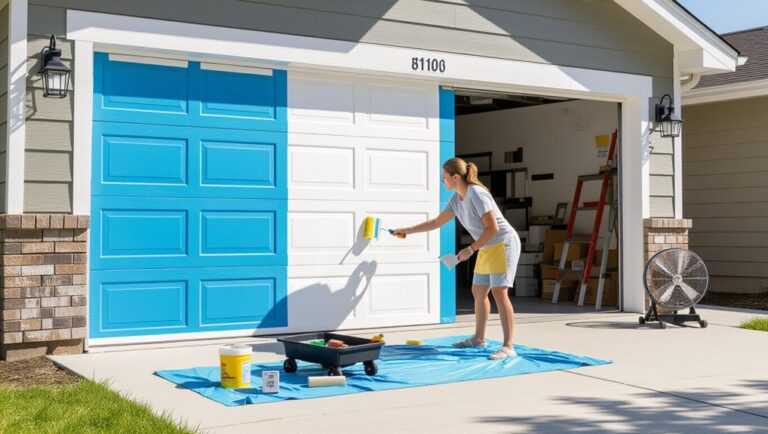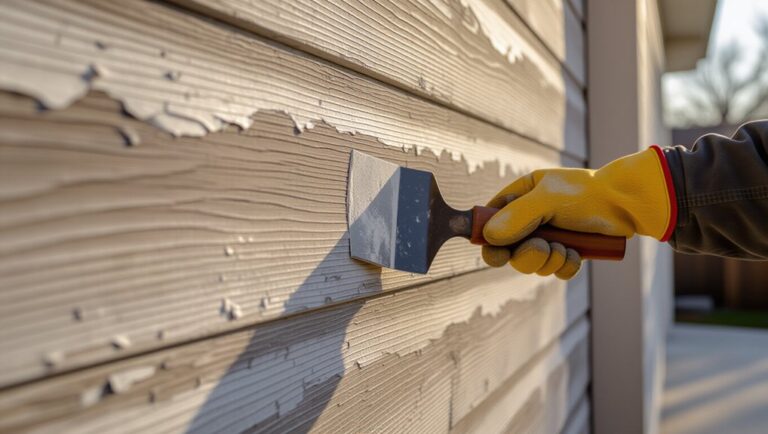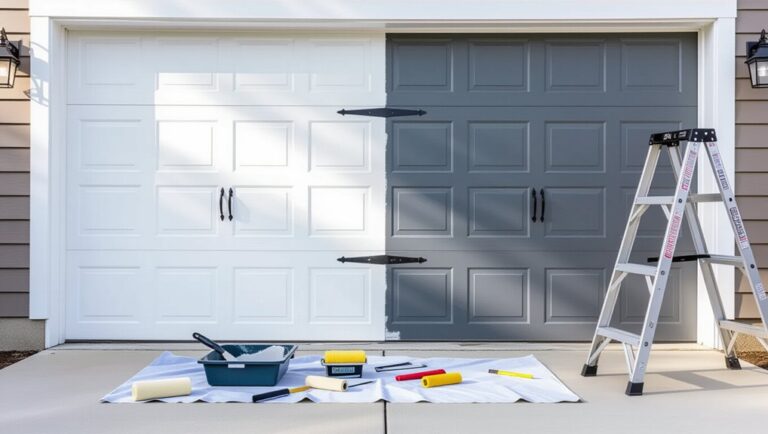
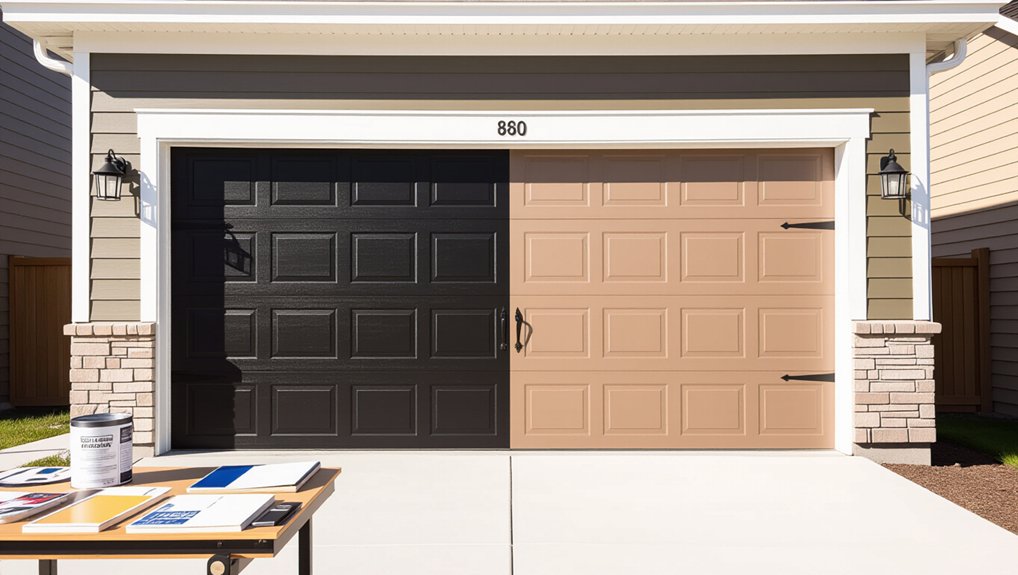
Start by identifying your garage door material (wood, steel, aluminum, vinyl, or fiberglass) so you can match the correct bonding or rust-inhibitive primer. Wash off chalking and grime, scrape loose paint, sand glossy areas, and caulk open seams to stop moisture intrusion. Choose a 100% acrylic, UV-stable exterior paint with documented weathering performance, and avoid dark colors that overheat and crack. Apply in small sections to prevent lap marks; keep going for more ways to maximize longevity.
Key Takeaways
- Identify the door material (wood, steel, aluminum, vinyl, fiberglass) so you can choose a compatible, high-adhesion exterior primer and paint.
- Select a premium exterior paint labeled UV-resistant, with proven weathering performance and stabilizers (UV absorbers/HALS) to reduce fading and chalking.
- Favor lighter, UV-stable colors with inorganic pigments; avoid dark shades that overheat, accelerate cracking, and increase gloss loss on south-facing doors.
- Choose an appropriate sheen—satin or semi-gloss for durability—while avoiding high gloss on textured panels where glare and imperfections show more.
- Confirm the paint system tolerates heat and rapid drying; follow prep and application instructions to prevent adhesion failure and lap marks.
What Harsh Sun Does to a Garage Door
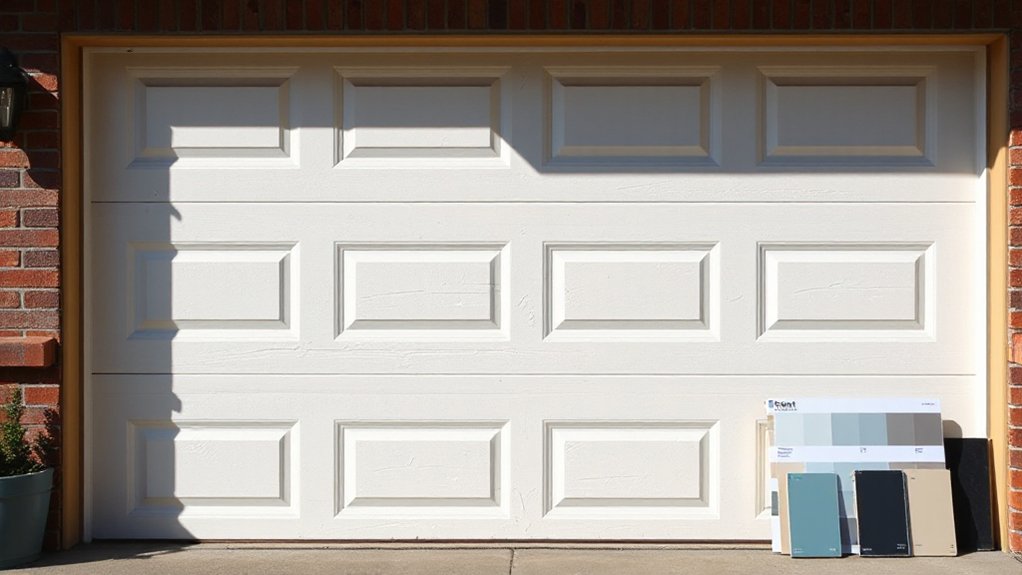
Because a south-facing garage door takes the brunt of daily UV exposure, heat load, and glare, the sun doesn’t just “fade the color”—it steadily breaks down the door’s finish and the material beneath it. You’ll see Sun damage as chalking, where binders oxidize and pigment releases as powder, leaving a dull, uneven sheen. UV degradation also embrittles topcoats, so microcracks form, then expand with thermal cycling. As the panel heats and cools, it moves; that stress weakens adhesion and opens paths for moisture intrusion at seams and edges. Glare highlights every lap mark and repair, so inconsistent film build becomes obvious. If you ignore these mechanisms, you’ll repaint sooner and spend more on prep and spot-fixing.
Identify Your Garage Door Material First
Before you choose paint for a south-facing garage door, you need to confirm the door’s substrate because primer selection, adhesion, and heat tolerance depend on it. Verify whether you’re working with solid wood versus composite, then identify the specific metal type (steel or aluminum) so you can match corrosion control and coating chemistry. If the door is vinyl or fiberglass, check for factory coatings and surface energy limits, since they’ll dictate scuff-sanding requirements and compatible exterior topcoats.
Determine Wood Or Composite
Even if you’ve already chosen a color, you’ll get better performance on a south-facing garage door by confirming whether the surface is solid wood or a composite/engineered product first. Check edges, panel backs, and any cutouts: solid wood shows continuous Wood grain and end-grain pores, while composites often show uniform fiber texture, factory-primed skins, or laminated faces.
If it’s wood, plan for higher movement and UV stress—use an exterior bonding primer and a flexible, high-solids topcoat to reduce checking along grain lines. If it’s composite, prioritize adhesion over penetration: scuff-sand lightly, clean with a residue-free degreaser, then prime per manufacturer specs. Composite durability improves when you keep film builds even and seal all seams, joints, and exposed fibers before finish coats.
Assess Metal Door Type
Although most “metal” garage doors look similar at a glance, you’ll get a longer-lasting south-facing paint job by identifying whether you’re dealing with steel (galvanized or Galvalume) or aluminum, and whether the panels are factory-baked polyester (coil-coated) or previously field-painted. Check the door edge, fasteners, and any exposed cutouts: galvanized steel often shows a spangle; Galvalume looks smoother; aluminum won’t attract a magnet. Note any white oxidation on aluminum or red/brown staining on steel—both signal Metal corrosion that must be treated before priming. For coil-coated panels, scuff-sand and solvent-wipe to improve paint adhesion; they’re slick and UV-cured. For field-painted surfaces, do a crosshatch tape test and address chalking, peeling, or incompatible layers before you specify primer.
Check Vinyl Or Fiberglass
Because vinyl and fiberglass doors can look like painted steel from the curb, you should confirm the substrate before you choose prep and primer—these plastics move more with heat and don’t tolerate the same solvents or abrasion levels. Check the door’s label on the inside edge, tap for a hollow sound, and inspect any chips: vinyl shows a uniform color through the cut, while fiberglass reveals a resin-and-fiber matrix. For vinyl, protect Vinyl durability by washing with mild detergent, scuffing lightly with a gray pad, and using a bonding primer rated for PVC; avoid lacquer thinner and aggressive sanding that can fuzz the surface. For fiberglass, preserve Fiberglass aesthetics by repairing hairline cracks, feathering edges gently, and priming with an acrylic bonding or epoxy primer before topcoating.
Choose the Right Primer for That Material
When you’re painting a south-facing garage door, match the primer to the door’s substrate and existing coating so the finish can handle higher surface temperatures, stronger UV exposure, and wider expansion–contraction cycles without peeling. For steel, use a rust-inhibitive acrylic or epoxy metal primer; spot-prime any bare areas and choose products rated for exterior heat exposure. For wood, choose an exterior alkyd or acrylic bonding primer to lock down tannins and improve adhesion; switch to stain-blocking formulas on cedar or redwood. For aluminum, use an etching or self-etching primer designed for nonferrous metals. For vinyl or fiberglass, select a high-adhesion acrylic bonding primer labeled for plastics and glossy surfaces. Verify Primer types and Material compatibility on the tech sheet before buying.
Prep a South-Facing Garage Door for Heat
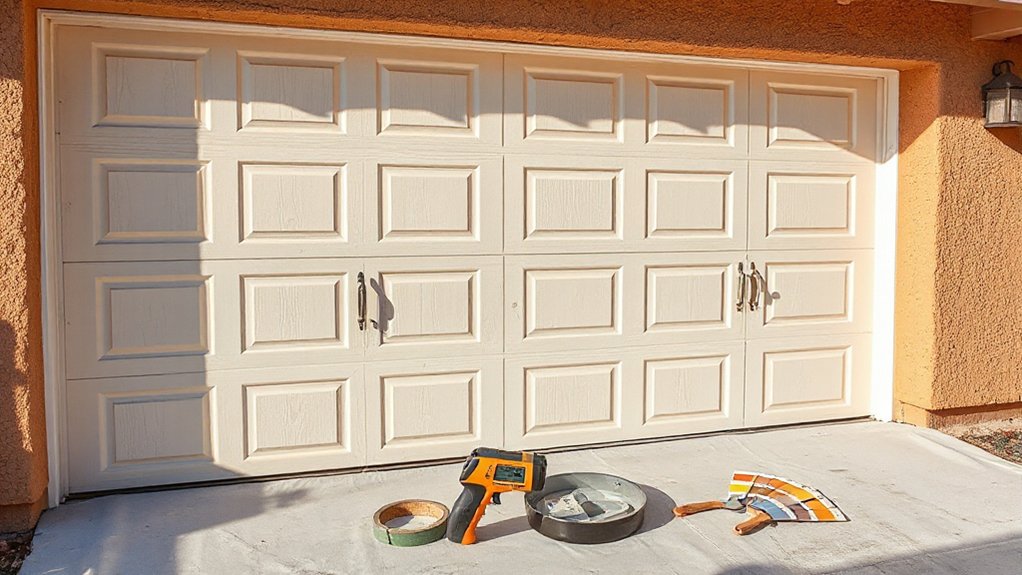
Before you crack open a paint can, prep the door to manage the extra heat load a south-facing exposure creates. Start by washing off chalking, oils, and road grit, then rinse and let it dry fully so trapped moisture won’t blister later. Scrape loose coatings, feather edges, and sand glossy areas to a uniform profile for mechanical bonding. Caulk open joints at trim and panel seams with a paintable exterior sealant; it limits hot-air pumping behind the film. Add Garage door insulation if the door skins flex or the interior heats up; stable substrates reduce stress on coatings. Replace brittle bottom seals and cracked perimeter weatherstripping—key weatherproofing tips that cut drafts and reduce temperature swings. Verify fasteners are tight and panels are aligned.
Pick Exterior Paint Rated for High UV
Although your prep work sets the foundation, a south-facing garage door still needs an exterior paint system specifically rated for high UV to prevent rapid fading, chalking, and film breakdown. Check the label for “UV-resistant,” “maximum sunlight,” or “exterior trim/door” performance claims, and confirm it meets ASTM weathering standards or offers extended fade protection. Choose products that specify high-quality UV absorbers and hindered amine light stabilizers (HALS) to maintain gloss and color. Use Color psychology to pick hues that won’t visually amplify heat stress; mid-tones and lower-chroma colors typically mask minor fading better than saturated brights. Match paint texture to exposure: smoother films shed dirt and reduce chalk visibility, while heavy textures can trap grime and highlight oxidation. Ask for a compatible UV-rated clearcoat only if approved.
Acrylic Latex vs. Oil Paint for Garage Doors
High-UV ratings tell you a coating can take the sun, but the resin chemistry still determines how well that protection holds up on a south-facing garage door. Acrylic latex forms a flexible film that moves with daily heat cycling, so you’ll see fewer hairline cracks at panel joints. It also breathes, helping moisture escape from wood doors and reducing blister risk. Oil-based paint cures harder and levels beautifully, which can highlight historical trends like glossy carriage-house looks, but it can embrittle under repeated thermal swings and show more checking over time. For color psychology, acrylics maintain cleaner, truer whites and mid-tones, supporting modern curb-appeal palettes, while oils can warm slightly, shifting cool grays toward beige. Evaluate substrate and sheen goals.
Additives That Improve Fade and Chalk Resistance
When your garage door faces full southern exposure, you’ll get the best long-term color hold by choosing paints that pair UV-stable resins with the right additive package. Look for formulations with UV absorbers (benzotriazoles) and HALS light stabilizers; they intercept UV energy and slow binder breakdown that causes fading.
To reduce chalking, specify premium pigments and dispersants that keep colorants evenly suspended, plus anti-chalk additives that reinforce the polymer matrix as it weathers. If you’re choosing deep tones in your Color palette, request “exterior-grade” colorants and confirm the tint system is rated for high-UV exposures. You should also verify mildewcides aren’t substituting for UV protection; they’re separate. Match these features to your Paint finish’s performance data and warranty language, not just marketing claims.
Choose a Sheen That Hides Flaws and Glare
Because a south-facing door throws hard light across every ridge and dent, your sheen choice controls both how many surface flaws you’ll see and how much glare you’ll get at peak sun. High-gloss and semi-gloss reflect sharply, so they highlight patch edges, roller stipple, and sanding swirls while producing mirror-like hot spots. For better flaw concealment, prioritize lower Sheen options like satin or low-lustre: they still clean well, yet their softer reflectance diffuses sunlight and reduces perceived waviness. If you need maximum glare control, consider a flat/matte exterior formulation rated for washability and burnish resistance; it minimizes specular reflection but can show scuffs sooner. Match sheen to your maintenance tolerance: higher sheen cleans easier, lower sheen hides more and photographs better.
Best Sheen by Door Texture (Smooth vs. Grained)
After you’ve narrowed sheen based on glare and washability, let the door’s texture make the final call. On a smooth steel or fiberglass door, semi-gloss can spotlight roller stipple, minor dents, and lap marks. You’ll usually get the most uniform read with satin or low-luster, which levels visually and keeps reflection controlled.
On a wood-grained or embossed panel, you can move up within your sheen options because the pattern breaks reflections. Satin often delivers the best texture enhancement, defining grain without making every ridge look plasticky. If the door has deep embossing and you need maximum scrub resistance, a restrained semi-gloss can work—apply with a fine microfiber roller and keep a wet edge to avoid picture-framing at panel borders.
Why Dark Garage Door Colors Fail Faster
Even if you choose a top-tier exterior paint, dark garage door colors take a harder beating on a south-facing elevation since they absorb more solar energy and run hotter for longer. That heat cycling expands and contracts the substrate, stressing the film and accelerating micro-cracking and edge failure. Higher surface temperatures also speed binder oxidation and pigment breakdown, so you’ll notice chalking, loss of gloss, and patchy fading sooner. On steel doors, heat can amplify panel oil-canning, which telegraphs through the coating; on wood or composite, it can worsen moisture movement and joint checking. Color psychology and historical trends may pull you toward deep charcoal or black for “premium” curb appeal, but you’ll budget for shorter repaint intervals and more prep between coats.
Colors That Resist Fading in Full Sun
To keep a south-facing garage door looking consistent, you’ll get the best results from UV-stable color families such as light-to-mid neutrals, soft earth tones, and muted blues/greens. You should also specify fade-resistant pigment systems—high-quality inorganic oxides and mixed-metal pigments typically outperform many organic colorants in full sun. Next, you’ll match your target shade to these pigment choices so you minimize chalking, color shift, and early recoat cycles.
UV-Stable Color Families
Because a south-facing garage door takes constant UV exposure, you’ll get the best fade resistance by choosing color families that rely on UV-stable inorganic pigments—think whites and off-whites, light-to-mid grays, beiges/tans, and other muted earth tones—rather than high-chroma organic reds, oranges, and some bright blues that tend to photodegrade faster.
To maintain color harmony with brick, siding, and roofing, stay in lower-saturation ranges and choose undertones that match fixed materials (warm greige with tan stone, cool gray with slate). Lighter values also reduce surface heat buildup, which supports paint durability by limiting thermal expansion and contraction at panel seams. If you want contrast, use charcoal or deep bronze sparingly on trim or hardware, not across the full door face. Always confirm the family with an exterior-rated fan deck in full sun.
Fade-Resistant Pigment Choices
UV-stable color families set the overall direction, but pigment chemistry determines how well your garage door’s finish actually holds up in full sun. You’ll get the best fade resistance from inorganic pigments like iron oxides (earth reds, browns, buffs), titanium dioxide for whites, and chromium oxide for muted greens. These pigments resist UV breakdown far better than many organic bright reds, blues, and violets, which can chalk or shift.
Ask your paint supplier for “lightfast” ratings, exterior-grade dispersions, and a high PVC balance that won’t overexpose pigment at the surface. If you want Color psychology benefits without rapid fading, choose lower-chroma versions of your target hue. Historical trends favor stable neutrals for a reason: they age predictably and match future touch-ups.
Whites That Won’t Look Blinding at Noon
When your garage door faces south, the midday sun drives reflectance to its peak, so a “clean white” can read as harsh glare. You’ll get a calmer result by choosing an off-white with a lower LRV and a touch of warm or gray undertone (think soft ivory, alabaster, or pale greige). Aim for an LRV in the mid-70s to low-80s rather than the 90s, which can bloom and wash out panel detail. Keep Color contrast in mind: pair the white with darker trim, hardware, or a shadow-line profile to preserve definition. Also consider window placement; glass inserts amplify highlights, so a slightly muted white reduces hotspotting around muntins and frames. Pick satin or low-sheen for controlled specular reflection.
Test Garage Door Color in Real Sunlight
Although a paint chip can look “right” indoors, you’ll only confirm the true hue, undertone, and glare level by testing the color on the door in full sun. Paint two 12″x12″ samples on the actual panel material, not cardboard, and place one near the top rail and one near the bottom to capture angle and shadow shifts. View them at 9 a.m., noon, and late afternoon, standing at curb distance and at the driveway approach.
Match sheen to your Garage door design: semi-gloss highlights texture and panel seams; satin softens imperfections. Check Color coordination against brick, trim, roof, and adjacent siding, and note how reflections from concrete warm or cool the read. Keep notes before you commit.
How to Spot Real “UV-Resistant” Paint Claims
Because “UV-resistant” isn’t a regulated label, you need to verify the claim by looking past the marketing and into the product’s technical data. Start with the TDS and look for resin type (100% acrylic or urethane-modified acrylic) and a stated exterior exposure rating. Check whether the manufacturer cites ASTM testing such as D4587 (QUV), G154, or D2244 color change, and whether results include gloss retention over time. Confirm the sheen and color guidance: deep bases and high-gloss films can show fade or chalking sooner on a south-facing door. Review the warranty for exclusions on color retention. If the SDS or TDS mentions UV absorbers or HALS, you’re more likely getting real UV protection and better paint durability.
Apply Paint Fast to Avoid Lap Marks
On a south-facing garage door, heat and sun shorten your open time, so you’ve got to apply paint quickly to prevent lap marks. Work in small, manageable sections and always maintain a wet edge so each pass blends before the film starts to set. Use a proper rolling technique—load evenly, keep consistent pressure, and back-roll in one direction—to level the coat without creating ridges.
Work In Small Sections
When you paint a south-facing garage door, heat and direct sun can flash-dry the coating, so you’ll need to work in small, controlled sections to keep a wet edge and prevent lap marks. Break the door into panels, stiles, rails, and the perimeter frame, and finish one segment before moving on. Load your roller or brush consistently, then spread paint in one direction to level it quickly. Keep your tool pressure light so you don’t pull semi-tacky film. Remove or mask garage door accessories like handles, hinges, and decorative straps so you can coat cleanly around fasteners. Seal gaps at trim joints with weatherproof sealants before painting; that prevents early skinning at edges and reduces touch-up stops that slow you down.
Maintain A Wet Edge
Even if you’re working panel by panel, you still need to maintain a wet edge so each pass of paint blends into the next before the surface tacks up in full sun. Plan your route so you always overlap into freshly applied paint by 1–2 inches, and don’t stop at mid-panel breaks where lap marks telegraph through sheen. Keep a loaded brush or pad moving at a steady pace, and stage your tools so you’re not searching while the film flashes off. If you must pause, stop at a natural boundary like a stile, rail, or seam. This matters more with bold Color combinations and high-contrast Design patterns, where slight thickness changes shift gloss and apparent shade. Work with your primer-to-topcoat timing.
Use Proper Rolling Technique
Because a south-facing garage door heats up fast, you need to roll with a “load–lay off–move” rhythm so the film levels before it flashes and leaves lap marks. Load your roller evenly, then apply paint in a tight “W” on one panel, filling it without stopping. Immediately lay off with light, single-direction passes to align texture and remove ridges. Keep your roller edge wet by overlapping 2–3 inches into the previous section, and don’t back-roll areas that have started to tack. Use consistent pressure; forcing the roller squeezes binder out and creates sheen bands. This Rolling technique improves paint application, giving uniform gloss and color, even in intense sun and heat.
Cure Times and Maintenance for Longer Life
Although the paint may feel dry to the touch within hours, you’ll only get full hardness and UV resistance after the coating completes its cure cycle. Plan for 7–30 days depending on resin type, film build, humidity, and temperature swings on a south-facing door. Don’t wash, tape, or install weatherstripping until cure is complete, or you’ll risk imprinting and premature gloss loss that reduces paint durability.
Protect the finish with smart maintenance. Rinse grit monthly and wash twice yearly using mild detergent, soft brush, and low-pressure water. Inspect edges and panel joints for early failure; touch up chips promptly to block moisture. Good surface preparation still matters later—keep seals tight and caulk cracks so heat and water can’t undermine adhesion.
Frequently Asked Questions
Do I Need HOA Approval Before Repainting My Garage Door?
You usually do need HOA approval before repainting your garage door. Review HOA regulations, confirm color and finish standards, and request repainting approval in writing. Document submissions and timelines, and keep receipts to support compliance later.
Can I Paint Over Factory-Finished or Powder-Coated Garage Doors?
Yes, you can paint over factory-finished or powder-coated doors if you clean, degloss, and prime correctly. Assess garage door finishes, then follow painting preparation: scuff-sand, solvent-wipe, apply bonding primer, and topcoat per specs.
What Temperature Range Is Safe for Painting a Garage Door?
Like tuning a cassette deck, you’ll paint safely between 50–85°F (10–29°C), with low humidity and steady shade. You’ll protect paint adhesion and color durability by avoiding hot sun, cold nights, and windy dust.
How Much Paint Will I Need for a Standard Two-Car Garage Door?
You’ll need about 1 gallon for a standard two-car garage door (200–220 sq ft) per coat; plan 2 gallons for two coats. Color choices and paint durability affect coverage; check label rates, add 10% waste.
Should I Remove Weatherstripping, Handles, and Hinges Before Painting?
Yes—like masking a circuit before service, you should remove or mask parts. Prioritize Weatherstripping removal if it’s loose, and complete Handle and hinge prep by removing hardware, labeling, cleaning, and reinstalling after curing.
Conclusion
South-facing garage doors take a beating: studies show UV can cause up to 80% of visible fading on exterior coatings over time. You’ll get longer service life when you match primer to your door material, prep for heat-driven expansion, and choose a true high-UV exterior paint with documented performance (not vague “sunproof” wording). Test your color in full sun, then paint quickly to avoid lap marks. Let it cure fully, and wash annually to protect the film.
About the Author